
2025-06-22
Iconic convenience store chain closing after long goodbye
The company has been living on borrowed time, and the much-loved name will soon disappear.
As an Amazon Associate I earn from qualifying purchases.

Know what the Bible says and understand why it matters with the fully revised NIV Study Bible featuring updated notes, full-color design, and Comfort Print typography designed for immersive reading.
A trusted companion for deep personal study, sermon prep, and devotional reading highlighted in our faith and leadership coverage.
The company has been living on borrowed time, and the much-loved name will soon disappear.
Bitcoin Plunges Below $100K as XRP and Dogecoin Prices Hit 2-Month Lows DecryptBitcoin Dips Below $100K as Iran Moves to Shut Strait of Hormuz Bitcoin.com NewsCrypto Market Liquidations Top $701M as US Strikes Hit Iran's Nuclear Facilities DecryptBTC, SOL, ADA, DOGE Bets Liquidated for $595M as U.S. Bombs Iran Nuclear Sites CoinDesk‘Doomsday Scenario’—Bitcoin Suddenly Drops Under $100,000 As Crypto Price Crash Fears Hit Ethereum And XRP Forbes

'Worst Ally': Army Colonel Removed From US Joint Chiefs Staff Over Israel Criticism A United States Army colonel has been removed from his position on the Pentagon staff supporting the Joint Chiefs after his Israel-critical social media posts were publicized by Jewish News Syndicate (JNS). Until this week, Army Col Nathan McCormack led the Joint Chiefs of Staff's Levant and Egypt branch. That team is part of the Joint Staff J5, which proposes strategies, plans, and policy recommendations to the chairman of the Joint Chiefs. Within hours of Tuesday's JNS report, McCormack was yanked from his post, with a Pentagon official telling JNS:“The individual is being returned to [the Army] while the matter is being investigated...The information on the X account does not reflect the position of the Joint Staff or the Department of Defense...Our global alliances and partnerships are vital to our national security, enhancing our collective defense, deterrence and operational reach.” Colonel Nathan McCormack was commissioned as an infantry second lieutenant two months after the United States invaded Iraq over false claims of a nuclear weapons program Here are the published comments that led to McCormack's removal: May 2025: "Netanyahu and his judeosupremacist cronies are determined to prolong the conflict for their own goals: either to remain in power or to annex the land."June 2024: "The more Israel's death cult escalates toward Hezbollah, the more we will see show-of-force attacks like this and 13 April." June 2024: “The U.S. has not been an honest broker. We have overwhelmingly enabled Israel’s bad behavior.”May 2024: Amid talk of pushing Gaza residents into other countries, McCormack wrote, "[Israel] wants to expel them and cleanse 'Eretz Israel' of ethnic Palestinians." April 2024: “I’ve lately been considering whether we might be Israel’s proxy and not realized it yet. Our worst ‘ally.’ We get literally nothing out of the ‘partnership’ other than the enmity of millions of people in the Middle East, Africa and Asia.” Oct 2023: "I agree that Israel has an absolute right to respond militarily, and that civilians may legally be caught in the crossfire, but you are ignoring the requirement of proportionality. Israel’s responses always (always—not hyperbole) disproportionately target Palestinian civilians." The JNS report that prompted McCormack's removal from the J5 gave no indication of how his semi-anonymous posts came to the pro-Israel outlet's attention. Up until his 2021 death, zealously pro-Israel billionaire and mega-campaign-contributor Sheldon Adelson was JNS's largest single donor. The JNS article included a disapproving quote from another Adelson-funded entity, the Foundation for Defense of Democracies, which -- despite its generic-sounding name -- declared in its initial tax-exempt-status-filing that its goal was to "enhance Israel's image in North America." McCormack's posts were made on X under an account using the name "Nate" and the handle "@mick_or_mack," with a profile that used a cartoon version of himself. His account no longer exists, but several of his posts are still viewable via internet archive links. McCormack didn't strive for full anonymity, as he once posted a photo of a Meritorious Service Medal certificate showing his full name. In May, he replied to an X user, "I’m the Joint Staff J5 Israel branch chief.” In Dec 2008, then-Captain McCormack speaks to a sheikh in Butoma, Iraq while serving as a 25th Infantry Division company commander (photo: US Army) The Pentagon told JNS another officer has been assigned to "look into the matter," but it's not clear that McCormack violated any Army policies. The branch's social media guide says "soldiers are encouraged to express their opinions of the political process online and offline." It advises soldiers to "avoid use of DoD titles, insignia, uniforms or symbols in a way that could imply DoD sanction or endorsement of content on your personal page." McCormack's profile included a disclaimer that his posts “do not represent the position of the Department of Defense or any of its components.” Then again, one of his posts might be read as attributing a position to the DOD, as he wrote:“Along with the World Health Organization and United Nations, we (Department of Defense, Department of State and the U.S. Intelligence Community) consider the Gaza Health Ministry figures to be generally reliable (though not precise), but probably less so now than they were originally due to the general destruction and chaos in Gaza.”Even if he's spared any formal discipline, it's safe to say there's zero chance McCormack will be returning to his position on the J5 staff. Beyond its general influence over US policy and personnel, Israel has a history of a strong presence directly inside the Pentagon. Here's how former Army Col. Lawrence Wilkerson -- who served as Secretary of State Colin Powell's chief of staff amid the run-up to the 2003 invasion of Iraq -- described what he witnessed: 🚨Col. Lawrence Wilkerson: ‘It’s UNQUESTIONABLE that the Epstein business was heavily influenced by MOSSAD!’‘I watched Mossad take over the Pentagon in 2002. The Pentagon was infiltrated by Mossad. They did not need any identification to get through the river entrance to the... pic.twitter.com/rZtnFTPc1k— Going Underground (@GUnderground_TV) June 9, 2025A Dallas native and Texas A&M graduate, McCormack was commissioned as an infantry second lieutenant just two months after the United States invaded Iraq based on the false pretense that Saddam Hussein was developing a nuclear weapon. As the United States contemplated that invasion, Benjamin Netanyahu told Congress: "There is no question whatsoever that Saddam is seeking and is working and is advancing towards the development of nuclear weapons—no question whatsoever.” "If you take out Saddam, I guarantee you that it will have enormous positive reverberations on the region." McCormack would later be deployed to Iraq, where he surely witnessed for himself the utter emptiness of Netanyahu's claims, and the catastrophic consequences of acting on them. As the Pentagon participated in deliberations over joining another Middle East war on nearly-identical premises, Colonel McCormack's contrarian perspective might have been particularly valuable at such a pivotal moment. Tyler DurdenSat, 06/21/2025 - 22:45

A transcript of President Donald Trump’s speech on U.S. airstrikes on Iran, which he delivered at the White House on Saturday night. Trump said, “Our objective was the destruction of Iran’s nuclear enrichment capacity and a stop to the nuclear...
FedEx founder Fred Smith dies, sources confirm WREG.comView Full Coverage on Google News

Friends of mine, prominent players in the New York City business community, tell me they are horrified that a certified socialist, Zohran Mamdani, might become our next mayor.
FedEx Founder Frederick Smith passes away, multiple sources confirm FOX13 MemphisFedEx founder Fred Smith has died localmemphis.comFedEx founder Fred Smith dies, sources confirm WREG.comFred Smith, FedEx founder and American business magnate, dies at 80 | Reports The Commercial AppealFred Smith family: All about FedEx founder's wife and children Hindustan Times
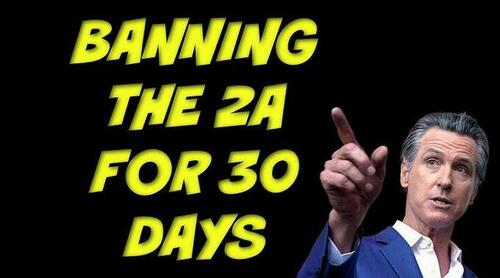
Ninth Circuit Strikes Down California's "1-In-30" Gun-Rationing Law Authored by Jonathan Turley,A unanimous panel of the United States Court of Appeals for the Ninth Circuit has struck down California’s “1-in-30” gun rationing law as unconstitutional under the Second Amendment.The law restricted citizens to one gun purchase every 30 days and was based on a ridiculous rationale that was shredded by the three-judge panel.California Penal Code § 27535(a) states that individuals may not apply “to purchase more than one firearm within any 30-day period,” and § 27540(f) prohibits a firearms dealer from delivering any firearm if the dealer is notified that “the purchaser has made another application to purchase a handgun, semiautomatic centerfire rifle, completed frame or receiver, or firearm precursor part” within the preceding 30-day period.Writing for the court, Judge Danielle Jo Forrest found the California law facially unconstitutional. She wrote:California suggests that the Second Amendment only guarantees a right to possess a single firearm, and that Plaintiffs’ rights have not been infringed because they already possess at least one firearm. California is wrong. The Second Amendment protects the right of the people to “keep and bear Arms,” plural. U.S. Const. amend. II (emphasis added). This “guarantee[s] the individual right to possess and carry weapons.” Heller, 554 U.S. at 592 (emphasis added).And not only is “Arms” stated in the plural, but this term refers to more than just guns. It includes other weapons and instruments used for defense. See id. at 581. California’s interpretation would mean that the Second Amendment only protects possession of a single weapon of any kind. There is no basis for interpreting the constitutional text in that way.The court rightfully dismisses the state’s forced and frankly frivolous argument.It then delivers a particularly lethal line on the historical prong of the analysis.Next, the panel held that California’s law is not supported by this nation’s tradition of firearms regulation. Bruen requires a “historical analogue,” not a “historical twin,” for a modern firearm regulation to pass muster. Here, the historical record does not even establish a historical cousin for California’s one-gun-a-month law.Here is the opinion: Nguyen v. Bontan Tyler DurdenSat, 06/21/2025 - 22:10
Democrats seem to be at odds once more when it comes to the Mideast. Even before President Donald Trump's announcement Saturday that the U.S. had struck Iranian nuclear sites, progressives demanded unified opposition of any U.S. such move. Party leaders...

“We have completed our very successful attack on the three Nuclear sites in Iran, including Fordow, Natanz, and Esfahan,” President Donald Trump said Saturday. The nuclear facilities were hit with massive bombs delivered from B-2 stealth bombers. U.S. Navy submarines also joined the attack, launching more than 30 Tomahawk missiles into Iran. Trump’s decision to join Israel’s war against Iran sharply escalates the conflict and appears to push any diplomatic solution out of reach. President Donald Trump on Saturday said the United States had attacked Iranian nuclear sites, pushing America into Israel‘s war with its longtime rival and regional power.“A short time ago, the U.S. military carried out massive precision strikes on the three key nuclear facilities in the Iranian regime, Fordo, Natanz and Isfahan,” Trump said in a speech from the White House.U.S. Navy submarines also launched more than 30 Tomahawk missiles into Iran, two defense officials told NBC News.Trump said the U.S. and Israel, “worked as a team, like perhaps no team has ever worked before. We’ve gone a long way to erasing this horrible threat” to the American ally.The president congratulated the U.S. military on “an operation the likes of which the world has not seen in many, many decades. Hopefully we will no longer need their services in this capacity.”“There will be either peace, or there will be tragedy for Iran far greater than we have witnessed over the last eight days. Remember, there are many targets left,” Trump said.“Tonight was the most difficult of them all by far, and perhaps the most lethal. But if peace does not come quickly, we will go after those other targets with precision, speed and skill, most of them can be taken out in a matter of minutes,” he added.Trump watched the strikes unfold Saturday from the White House Situation Room, where he was joined by his national security team and closest aides.White House | Via ReutersU.S. President Donald Trump holds a meeting alongside Secretary of State Marco Rubio in the Situation Room at the White House in Washington, D.C., U.S. June 21, 2025.The president initially announced the strikes on social media Saturday, where he wrote that “a full payload of BOMBS was dropped on the primary site, Fordow.”It was unclear late Saturday precisely how much damage the U.S. strikes had done to the heavily fortified Iranian nuclear sites, or whether any American military assets were still active in the country.Earlier in the day, several U.S. Air Force B-2 stealth bombers reportedly left Missouri, heading west over the Pacific Ocean. The massive planes are some of the only U.S. aircraft capable of carrying the GBU-57 Massive Ordnance Penetrator (MOP), a 30,000-pound bomb known as the “bunker buster.”The bunker buster bombs are widely viewed as the only conventional, non-nuclear weapons capable of inflicting serious damage on the Fordo nuclear facility, which is built into the side of a mountain.Saturday’s action puts the United States in direct armed conflict with Iran, a massive escalation in its involvement with Israel’s effort to cripple Tehran’s nuclear program and topple its regime.Trump spoke with Israeli Prime Minister Benjamin Netanyahu after the U.S. strikes, a White House official told NBC News.The decision to attack Iran once again engages the American military in active warfare in the Middle East — something Trump had vowed to avoid during his second term in office.It also marks a major shift from just 48 hours ago, when Trump said the United States would take “two weeks” to see if the conflict between Israel and Iran could be resolved diplomatically.“Based on the fact that there’s a substantial chance of negotiations that may or may not take place with Iran in the near future, I will make my decision whether or not to go within the next two weeks,” Trump said Thursday in a statement issued by the White House.Behind the scenes, the Trump administration has been trying to reach a deal with Iran over its nuclear program, and Trump in recent months had reportedly urged Netanyahu to hold off on a strike.Graphic by SYLVIE HUSSON, NALINI LEPETIT-CHELLA, SABRINA BLANCHARD| AFP | via Getty ImagesInfographic with a map of Iran showing nuclear sites, reactors and uranium mines. That diplomatic path may now be closed. Iranian Ayatollah Ali Khamenei said recently that “any American military entry will undoubtedly be met with irreparable damage.”“If they enter militarily, they will face harm that they cannot recover from,” he added in a statement read on Iranian state television.After the U.S. strikes, it was unclear what options remained for an Iranian retaliation against the United States.One possibility with direct impacts on the global economy and supply chain would be if Tehran were to set landmines down in the Strait of Hormuz, said Helima Croft, head of global commodity strategy at RBC Capital Markets.The narrow body of water between Iran and Oman is the transit point for about 20% of the world’s oil, via tanker ships. Landmines would effectively close the strait, because ships would not know where the mines were placed.“We’re already getting reports that Iran is jamming ship transponders very, very aggressively,” Croft told CNBC’s “Fast Money” on Wednesday.QatarEnergy and the Greek Shipping Ministry have already warned their vessels to avoid the strait as much as possible, Croft said.More such alerts were expected following Saturday’s U.S. attack on Iranian sites.Getty ImagesInfographic with map of the Gulf showing maritime tanker traffic in September 2024 through the Strait of HormuzTrump and previous American presidents have long insisted that Iran cannot have nuclear weapons.During his first term, Trump pulled the U.S. out of a nuclear agreement that the Obama administration and other nations had brokered with Iran in 2015, arguing it failed to protect America or deter Tehran’s enrichment aims.Israel has long claimed that Iran is developing nuclear weapons, and has threatened to strike its nuclear program before. But until now, Tel Aviv has limited its military engagement to targeted assassinations and cyber attacks.Tulsi Gabbard, Trump’s director of national intelligence, testified before Congress in March that the U.S. intelligence community “continues to assess that Iran is not building a nuclear weapon and Supreme Leader Khamenei has not authorized the nuclear weapons program that he suspended in 2003.”But Trump has repeatedly dismissed his own Cabinet official’s assessment.“I don’t care what she said. I think they were very close to having one,” Trump said on Air Force One last week. World leaders react after Trump says U.S. bombed nuclear sites in IranTrump rips into ‘too late’ Jerome Powell after Fed holds rates steadyA ‘spiral of escalation’: World braces for intensifying Iran-Israel conflictIsrael denies pursuing regime change in Iran; it aims to remove nuclear programIran threatens ‘irreparable damage’ if U.S. enters Israel conflictThese are the sticking points holding up a U.S.-EU trade dealNYC mayoral candidate Brad Lander released after arrest by ICETrump weighs potential U.S. military strike on Iran, demands surrender

This is your weekly lookahead at the key global events that could move markets and shape policy. NATO leaders meet in The Hague with Trump expected to ramp up pressure on Europe over defense spending. Summer Davos kicks off in Tianjin amid China-U.S. trade tensions, while Germany hosts its Day of Industry as economic sentiment improves.After a week of global market jitters, the reaction to U.S. strikes on Iranian nuclear facilities will be front and center over the coming days. Meanwhile, a trio of heavyweight events could also shape the economic and geopolitical mood. From NATO tensions in The Hague to trade talks in Tianjin and industrial optimism in Berlin — investors will be watching closely. The stage is set for tense talks at the NATO Summit in The Hague on Wednesday where U.S. President Donald Trump is expected to exert further pressure on Europe to boost defense spending Summer Davos takes place in Tianjin, China from Tuesday to Thursday with China trade talks underway Day of Industry in Germany on Monday and Tuesday as engine of growth restartsU.S.-Iran-IsraelAddressing the nation on Saturday evening, U.S. President Donald Trump said strikes on three of Iran’s nuclear sites were a “spectacular military success” that “completely obliterated” the country’s major enrichment facilities.The strikes, which mark the first time the U.S. has conducted a direct military attack on Iran, mark a dramatic escalation in geopolitical tensions. Trump’s claim about the result of the operation could not be independently confirmed.Iran Foreign Minister Abbas Araghchi slammed the U.S. strikes, describing them as “outrageous” and saying the country “reserves all options to defend its sovereignty, interest, and people.” Global investors will be scrambling to assess the fallout.On the DefensiveNATO meetings with Trump in attendance have a history of being dramatic. Back in 2017, the White House leader consistently questioned America’s commitment to the alliance, and accused other members of owing “massive amounts of money” to the overall share of defense spending.Fast forward to 2025 and the next NATO Leaders Summit with Trump is set to take place in The Hague, the Netherlands on Wednesday. Some problems are familiar – while defense spending has increased dramatically across Europe, countries like Spain risk derailing talks by calling the 5% of GDP target “unreasonable.” In addition, the war in Ukraine rages on. Meanwhile other problems are new – hostilities are rising between Israel and Iran, alongside other neighbors in the Middle East, are testing international relations to the limit. U.S. Ambassador to NATO Matthew Whittaker, told CNBC’s “Squawk Box Europe” that the region should not expect a free ride from the U.S. on defense spending, as “the 5% target is not a negotiating tactic.” Summer DavosOn the other side of the world, the Chinese city of Tianjin plays host to the World Economic Forum’s Meeting of New Champions running from Tuesday to Thursday, also known as the Summer Davos. Technology dominates the agenda at a tricky time for relations between China and the West, as trade negotiations with the U.S. are still on-going.Trump may have bought more time for TikTok, extending the deadline for China’s ByteDance to divest the social media platform’s U.S. business to September, but the latest round of trade talks in London led to a vague stand-off between the two superpowers, with no official readout. Speaking to CNBC right after those negotiations, U.S .Commerce Secretary Howard Lutnick was asked if current tariffs on China would not shift again, to which he replied, “you can definitely say that.”But this may do little to ease the conversations between Chinese officials and corporates in Tianjin, and the international delegates in attendance, who will be looking for more certainty from both the White House and Beijing.Engine of GrowthCloser to home, it’s the Day of Industry conference in Germany on Monday and Tuesday. This annual meeting in Berlin highlights German economic policy and global trade strategies. It could be a good time for the new government to be touting Europe’s so-called Engine of Growth, with four economic institutes raising their 2025 and 2026 GDP growth forecasts for Europe’s largest economy.During a recent trip to Washington DC, Chancellor Friedrich Merz dodged the ire that other world leaders have faced in the Oval Office, with Trump’s focus mostly dominated by his public spat with Elon Musk. But it’s not all clear roads ahead for Germany, as the country’s auto industry body reports that domestic auto-makers have shouldered around 500 million euros ($576.1 million) in costs associated with Trump’s import tariffs.

You might see this retailer disappear from your town soon.

Billionaire Mark Cuban has revealed that the Kamala Harris campaign sought to vet him for the 2024 Democratic vice presidential nomination, an offer he chose to decline.What Happened: Cuban, ex-owner of the Dallas Mavericks, was asked by the Harris campaign to submit vetting documents for the VP role. The billionaire confirmed the rumor during an interview on Friday.Cuban justified his decision by stating in the interview, “I’m not very good as the number two person.” He further confessed his discomfort with the traditional vice presidential duties of “shaking hands ...Full story available on Benzinga.com
Ohio power grid operator raises red flag as heat and industry drive demand 10TVPJM Issues Hot Weather Alert for Expected Heat Wave June 22–25 PJM Inside LinesPA PUC OFFERS TIPS TO KEEP COOL wccsradio.comState preps for higher heat, humidity next week; power demand forecast for electric utilities WGRZPUC Highlights #WaysToStayCool as Heat Wave Arrives – While Also Addressing Widespread Storm-Related Power Outages Beaver County Radio
29 Everyday Groceries That Used To Be Cheap But Are Now Basically A Luxury BuzzFeed

Omi, a Paris-based startup revolutionizing product visuals with 3D modeling and artificial intelligence, has won the "Most Promising" prize at the 2024 LVMH Innovation Awards. The award was presented on June 12 in Paris at leading European tech conference VivaTech, hosted by LVMH Image and Environment Director Antoine Arnault.Hugo Borensztein, co-founder and CEO of Omi, said the win reflects a broader shift happening across the luxury and retail industries. “Working with a Maison founded two centuries ago using the most advanced 3D and AI technologies expresses LVMH's bold, innovation-inspired vision. We are both honored and proud to be part of this adventure," Borensztein said in a statement by LVMH.Don't Miss:Maker of the $60,000 foldable home has 3 factory buildings, 600+ houses built, and big plans to solve housing — this is your last chance to become an investor for $0.80 per share.Peter Thiel turned $1,700 into $5 billion—now accredited investors are eyeing this software company with similar breakout potential. Learn how you can invest with $1,000 at just $0.30/share.Omi Offers AI-Driven Visuals For The Future Of Luxury RetailOmi specializes in using 3D technology ...Full story available on Benzinga.com
Energy Secretary Chris Wright announced an ambitious plan to have three small modular reactors (SMRs) built and producing power at the Idaho National Laboratory (INL) by July 4, 2026. This initiative was revealed during a Senate Energy and Natural Resources Committee hearing on June 18, aligning with President Donald Trump’s executive orders to boost domestic [...]

Popular recording artist closes his Las Vegas Strip residency.

Probably like you, I’ve been trying to figure out why the Trump administration is rife with science denial. At first I attributed it to anti-intellectualism. With that, I thought, went an ideological mindset in which people identified with superficialities like He Who Dies with the Most Toys Wins. But that ... [continued]The post Trump 2.0 And Science Denial — Alice In Wonderland For The 21st Century appeared first on CleanTechnica.
Ranked: Countries With the Highest Share of Seniors Visual Capitalist
SAN DIEGO, June 21, 2025 (GLOBE NEWSWIRE) -- The law firm of Robbins Geller Rudman & Dowd LLP announces that purchasers of Tempus AI, Inc. (NASDAQ:TEM) common stock between August 6, 2024 and May 27, 2025, both dates inclusive (the "Class Period"), have until August 12, 2025 to seek appointment as lead plaintiff of the Tempus AI class action lawsuit. Captioned Shouse v. Tempus AI, Inc., No. 25-cv-06534 (N.D. Ill.), the Tempus AI class action lawsuit charges Tempus AI and certain of Tempus AI's top executives with violations of the Securities Exchange Act of 1934.If you suffered substantial losses and wish to serve as lead plaintiff of the Tempus AI class action lawsuit, please provide your information here:https://www.rgrdlaw.com/cases-tempus-ai-inc-class-action-lawsuit-tem.htmlYou can also contact attorneys J.C. Sanchez or Jennifer N. Caringal of Robbins Geller by calling 800/449-4900 or via e-mail at [email protected] ALLEGATIONS: Tempus AI is a technology company advancing precision medicine through the practical application of artificial intelligence, including generative AI.The Tempus AI class action lawsuit alleges that defendants throughout the Class Period made false and/or misleading statements and/or failed to disclose that: (i) Tempus AI inflated the ...Full story available on Benzinga.com
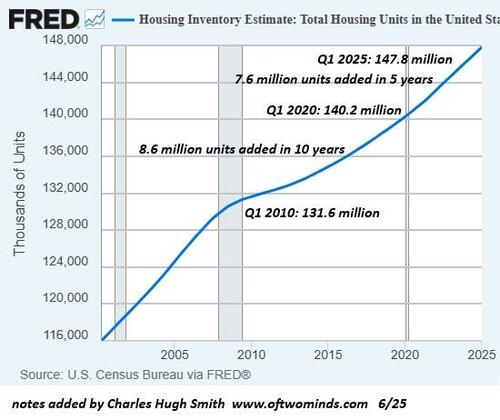
How Housing Bubble #2 Bursts? Authored by Charles Hugh Smith via OfTwoMinds blog,Corporate / private equity / STVR investors are all fair-weather owners of housing.Let's indulge in some basic logic:1. All credit-asset bubbles burst.2. U.S. housing is a credit-asset bubble.3. The U.S. housing bubble will burst.The only variables are how and when Housing Bubble #2 will burst. That's today's topic.I've been writing about housing since 2005, as Housing Bubble #1 was inflating. I've participated in / observed housing rising sharply in the late 1970s and the late 1980s, followed by deflation / stagnation. Housing Bubble #1--circa 2003-2008--was characterized by all the classic signs of a mania:1. Participants denied it was a bubble. When greed displaces prudence, this isn't a bubble doomed to pop, it's the New Normal.2. Fraud, malfeasance, misrepresentation, speculation and leverage were all rampant. In the euphoric ascent to ever higher valuations, why let foolish little things like income, risk management and credit ratings stand in the way of reaping more profits?Housing Bubble #2 has rolled over into the decline phase, but this is discounted by the consensus which holds that higher mortgage rates dented the market; once they drop a bit, housing will resume its ascent to ever-higher valuations.I see a different set of dynamics in play:1. The 40+ year cycle of interest rates / bond yields has turned. Rates will not go back to zero and stay flatlined for years. Risk and inflationary forces have changed and are not returning to The Great Moderation.2. The Federal Reserve / federal government effectively nationalized the mortgage industry post-2009 Global Financial Meltdown as the means to stop the decline of housing valuations and re-inflate them via super-low mortgage rates. The Fed bought a staggering $1.2 trillion of mortgage-backed securities in 2009-2010, up from zero--a monumental manipulation of the mortgage market that soon exceeded $1.6 trillion.How the housing/mortgage market managed to survive without Fed nationalization prior to 2009 remains a mystery.For its part, the federal government effectively nationalized the quasi-governmental mortgage agencies (Fannie Mae, Freddy Mac), using these agencies to guarantee most mortgages in the U.S.3. The incentive (lower mortgage rates) to commit fraud by claiming to be an owner-occupant rather than an investor has pushed mortgage fraud to levels that Federal Reserve researchers declare "rampant." Owner-Occupancy Fraud and Mortgage Performance (A 46-page PDF report is available on this link.)The study's authors found that "in most years, fraudulent investors make up roughly one-third of the total pool of investors." Fraud rates in excess of 13% were found in some states states.The frenzy to buy and convert houses to short-term vacation rentals (STVRs) took off in the post-pandemic "revenge travel" boom. Corporate purchases of houses as rental properties had taken off in the post-2009 era of mass foreclosures, a trend that accelerated as private equity sought new markets to exploit.Combine corporate / private-equity buyers with small investors flooding into STVRs and the post-pandemic panic-buying frenzy, and it's little wonder that investors--declared and fraudulent, large and small--now own huge swaths of housing in the U.S.:Investors Bought 26% of the Country's Most Affordable Homes in the Fourth Quarter--the Highest Share on RecordAn estimated 26% of Fort Worth's single family homes are owned by companies, city says(Yes, family trusts and households can own housing as LLCs, but the study linked above paid no attention to the type of ownership; it paid attention to A) if the owners have multiple first liens, and B) whether they moved following the origination of their new purchase mortgage or not.)4. The risks created by this preponderance of investor ownership are high. The Federal Reserve researchers found that fraudulent investors pose a much higher risk of default than declared investors and real owner-occupants.As "revenge travel" shrivels up, property taxes and insurance rise and inflation ravages household budgets, STVRs are quickly shifting from income-producing assets to loss-generating liabilities. Investors either sell before they're under-water or the risk of default rises accordingly.Professionally managed corporate and private-equity owners will start unloading properties as rents sag and vacancies rise. STVR owners who realize the tide has reversed will also rush to sell before the price slide gathers momentum.Let's look at some charts for context. Here is a chart of total housing units. Confounding the conventional narrative of a "housing shortage," the U.S. added 7.6 million housing units in the five years 2020-2025, a rate far higher than the 8.6 million units added over 10 years 2010-2020.Here is a chart of owner-occupied housing. Note that the number of owner-occupied homes was flatlined for 12 years--from 2005 to 2016. Then it suddenly leaps up by 10 million in a few years--from 76 million to 86 million. Did 10 million households all win the lottery, or is the bulk of this astounding increase the result of fraudulent investors posing as owner-occupant buyers?This map shows the extent of investor mortgage -fraud.This chart of Federal Reserve ownership of mortgage-backed securities (MBS) overlays neatly with each leap higher in valuations. Pump "free money" into the financial system and keep rates at historic lows, and voila, you can inflate a bubble for the ages.The post-pandemic buying frenzy pushed the cost per square foot of houses listed for sale up 57%.Unsurprisingly, this bubble pushed housing affordability to record lows.The Case-Shiller Index offers a long-term view of how far valuations could drop once the bubble bursts. A 40% decline would be the norm, and a 50% drop would be well within the typical range of bubbles bursting.The Fed's mass manipulation of mortgage rates in 2010 "saved" Bubble #1 from playing out in a free-market manner, but the Fed won't be able to engineer an equivalent "save" this time around, as the mortgage market has already been nationalized and the Fed already owns a stupendous $2.1 trillion of MBS.Corporate / private equity / STVR investors are all fair-weather owners of housing. Once the profits shrink or reverse into losses, investors push the "sell" button. And since housing is priced on the margins, it only takes a handful of get-me-out sales to push valuations down 10%, then 20%, then 30% and eventually to a bottom between 40% anf 50%.This vulnerability to the collapse of valuations is the bitter fruit of the Fed's manipulation of rates and mortgages over the past 16 years. We love a "free market" when rapidly expanding credit inflates a bubble, but oh dearie-dearie me, we have to stop the "free market" from operating if it bursts the bubble.Here's how Housing Bubble #2 bursts: buyers of overvalued, money-losing properties vanish, those who waited too long sink underwater (sales prices are lower than what they paid), marginal investors default, owner-occupants who lose their jobs sell or default, private equity realizes their losses will only increase the longer they hold off selling, and the momentum of sellers far outnumbering buyers cascades.Greed is replaced by fear, and then by the realization it's too late to exit without losses. This is how bubbles burst.* * *Become a $3/month patron of my work via patreon.com. Subscribe to my Substack for free Tyler DurdenSat, 06/21/2025 - 10:30

The Real National Emergency: Endless Wars, Failing Infrastructure, & A Dying Republic Authored by John Whitehead and Nisha Whitegead via The Rutherford Institute,“Every gun that is made, every warship launched, every rocket fired signifies, in the final sense, a theft from those who hunger and are not fed, those who are cold and are not clothed.”- President Dwight D. Eisenhower (April 16, 1953)Seventy years after President Dwight D. Eisenhower warned about the cost of a military-industrial complex, America is still stealing from its own people to fund a global empire.In 2025 alone, the U.S. has launched airstrikes in Yemen (Operation Rough Rider), bombed Houthi-controlled ports and radar installations (killing scores of civilians), deployed greater numbers of troops and multiple aircraft carriers to the Middle East, and edged closer to direct war with Iran in support of Israel’s escalating conflict.Each of these “new” fronts has been sold to the public as national defense. In truth, they are the latest outposts in a decades-long campaign of empire maintenance—one that lines the pockets of defense contractors while schools crumble, bridges collapse, and veterans sleep on the streets at home.This isn’t about national defense. This is empire maintenance.It’s about preserving a military-industrial complex that profits from endless war, global policing, and foreign occupations—while the nation’s infrastructure rots and its people are neglected.The United States has spent much of the past half-century policing the globe, occupying other countries, and waging endless wars.What most Americans fail to recognize is that these ongoing wars have little to do with keeping the country safe and everything to do with propping up a military-industrial complex that has its sights set on world domination.War has become a huge money-making venture, and the U.S. government, with its vast military empire, is one of its best buyers and sellers.America’s role in the Russia-Ukraine conflict has already cost taxpayers more than $112 billion.And now, the price of empire is rising again.Clearly, it’s time for the U.S. government to stop policing the globe.The U.S. military reportedly has more than 1.3 million men and women on active duty, with more than 200,000 of them stationed overseas in nearly every country in the world.American troops are stationed in Somalia, Iraq and Syria. In Germany, South Korea and Japan. In Saudi Arabia, Jordan and Oman. In Niger, Chad and Mali. In Turkey, the Philippines, and northern Australia.Those numbers are likely significantly higher in keeping with the Pentagon’s policy of not fully disclosing where and how many troops are deployed for the sake of “operational security and denying the enemy any advantage.” As investigative journalist David Vine explains, “Although few Americans realize it, the United States likely has more bases in foreign lands than any other people, nation, or empire in history.”Incredibly, America’s military forces aren’t being deployed abroad to protect our freedoms here at home. Rather, they’re being used to guard oil fields, build foreign infrastructure and protect the financial interests of the corporate elite. In fact, the United States military spends about $81 billion a year just to protect oil supplies around the world.America’s military empire spans nearly 800 bases in 160 countries, operated at a cost of more than $156 billion annually. As Vine reports, “Even US military resorts and recreation areas in places like the Bavarian Alps and Seoul, South Korea, are bases of a kind. Worldwide, the military runs more than 170 golf courses.”This is how a military empire occupies the globe.For 20 years, the U.S. war machine propped up Afghanistan to the tune of trillions of dollars and thousands of lives lost. When troops left Afghanistan, the military-industrial complex simply shifted theaters—turning Yemen, Iran, and the Red Sea into new frontlines.Each new conflict is marketed as national defense. In reality, it’s business as usual for the Pentagon's global footprint, with American soldiers used as pawns in the government's endless quest to control global markets, prop up foreign regimes, and secure oil, data, and strategic ports—all while being told it’s for liberty.This is how the military-industrial complex, aided and abetted by the likes of Donald Trump, Joe Biden, Barack Obama, George W. Bush, Bill Clinton and others, continues to get rich at taxpayer expense.Yet while the rationale may keep changing for why American military forces are policing the globe, these wars abroad aren’t making America—or the rest of the world—any safer, are certainly not making America great again, and are undeniably digging the U.S. deeper into debt.War spending is bankrupting America.Although the U.S. constitutes only 5% of the world's population, America boasts almost 50% of the world's total military expenditure, spending more on the military than the next 19 biggest spending nations combined.In fact, the Pentagon spends more on war than all 50 states combined spend on health, education, welfare, and safety.The American military-industrial complex has erected an empire unsurpassed in history in its breadth and scope, one dedicated to conducting perpetual warfare throughout the earth.Since 2001, the U.S. government has spent more than $10 trillion waging its endless wars, much of it borrowed, much of it wasted, all of it paid for in blood and taxpayer dollars.Add Yemen and the Middle East escalations of 2025, and the final bill for future wars and military exercises waged around the globe will total in the tens of trillions.Co-opted by greedy defense contractors, corrupt politicians and incompetent government officials, America’s expanding military empire is bleeding the country dry at a rate of more than $32 million per hour.In fact, the U.S. government spent more money every five seconds in Iraq than the average American earns in a year.Talk about fiscally irresponsible: the U.S. government is spending money it doesn’t have on a military empire it can’t afford.Even if we ended the government’s military meddling today and brought all of the troops home, it would take decades to pay down the price of these wars and get the government’s creditors off our backs.As investigative journalist Uri Friedman puts it, for more than 15 years now, the United States has been fighting terrorism with a credit card, “essentially bankrolling the wars with debt, in the form of purchases of U.S. Treasury bonds by U.S.-based entities like pension funds and state and local governments, and by countries like China and Japan.”War is not cheap, but it becomes outrageously costly when you factor in government incompetence, fraud, and greedy contractors. Indeed, a leading accounting firm concluded that one of the Pentagon’s largest agencies “can’t account for hundreds of millions of dollars’ worth of spending.”Unfortunately, the outlook isn’t much better for the spending that can be tracked.A government audit found that defense contractor Boeing has been massively overcharging taxpayers for mundane parts, resulting in tens of millions of dollars in overspending. As the report noted, the American taxpayer paid:$71 for a metal pin that should cost just 4 cents; $644.75 for a small gear smaller than a dime that sells for $12.51: more than a 5,100 percent increase in price. $1,678.61 for another tiny part, also smaller than a dime, that could have been bought within DoD for $7.71: a 21,000 percent increase. $71.01 for a straight, thin metal pin that DoD had on hand, unused by the tens of thousands, for 4 cents: an increase of over 177,000 percent.The fact that such price gouging has become an accepted form of corruption within the American military empire is a sad statement on how little control “we the people” have over our runaway government.Mind you, this isn’t just corrupt behavior. It’s deadly, downright immoral behavior.Americans have thus far allowed themselves to be spoon-fed a steady diet of pro-war propaganda that keeps them content to wave flags with patriotic fervor and less inclined to look too closely at the mounting body counts, the ruined lives, the ravaged countries, the blowback arising from ill-advised targeted-drone killings and bombing campaigns in foreign lands, or the transformation of our own homeland into a warzone.The bombing of Yemen’s Ras Isa port by U.S. forces—killing more than 80 civilians—is just the latest example of war crimes justified as national interest.That needs to change.The U.S. government is not making the world any safer. It’s making the world more dangerous. It is estimated that the U.S. military drops a bomb somewhere in the world every 12 minutes. Since 9/11, the United States government has directly contributed to the deaths of around 500,000 human beings. Every one of those deaths was paid for with taxpayer funds.With the 2025 escalation, those numbers will only rise.The U.S. government is not making America any safer. It’s exposing American citizens to alarming levels of blowback, a CIA term referring to the unintended consequences of the U.S. government’s international activities. Chalmers Johnson, a former CIA consultant, repeatedly warned that America’s use of its military to gain power over the global economy would result in devastating blowback.The 9/11 attacks were blowback. The Boston Marathon Bombing was blowback. The attempted Times Square bomber was blowback. The Fort Hood shooter, a major in the U.S. Army, was blowback.The U.S. military’s ongoing drone strikes will, I fear, spur yet more blowback against the American people.The war hawks’ militarization of America—bringing home the spoils of war (the military tanks, grenade launchers, Kevlar helmets, assault rifles, gas masks, ammunition, battering rams, night vision binoculars, etc.) and handing them over to local police, thereby turning America into a battlefield—is also blowback.James Madison was right: “No nation could preserve its freedom in the midst of continual warfare.” As Madison explained, “Of all the enemies to public liberty war is, perhaps, the most to be dreaded because it comprises and develops the germ of every other. War is the parent of armies; from these proceed debts and taxes... known instruments for bringing the many under the domination of the few.”We are seeing this play out before our eyes.The government is destabilizing the economy, destroying the national infrastructure through neglect and a lack of resources, and turning taxpayer dollars into blood money with its endless wars, drone strikes and mounting death tolls.The nation’s infrastructure is in shambles. Public schools are underfunded. Mental health care is collapsing. Basic needs like housing, transportation, and clean water go unmet. Meanwhile, government contractors drop bombs on third-world villages and call it strategy.This isn’t just bad budgeting. It’s moral bankruptcy. A country that can’t care for its own people has no business policing the rest of the world.Bridges collapse, water systems fail, students drown in debt, and veterans sleep on the streets—while the Pentagon builds runways in the desert and funds proxy wars no one can explain.Clearly, our national priorities are in desperate need of overhauling.We are funding our own collapse. The roads rot while military convoys roll. The power grid fails while the drones fly. Our national strength is being siphoned off to feed a war machine that produces nothing but death, debt, and dysfunction.We don’t need another war. We need a resurrection of the republic.It’s time to stop policing the world. Bring the troops home. Shut down the military bases. End the covert wars. Slash the Pentagon’s budget. The path to peace begins with a full retreat from empire.At the height of its power, even the mighty Roman Empire could not stare down a collapsing economy and a burgeoning military. Prolonged periods of war and false economic prosperity largely led to its demise. As historian Chalmers Johnson predicts:The fate of previous democratic empires suggests that such a conflict is unsustainable and will be resolved in one of two ways. Rome attempted to keep its empire and lost its democracy. Britain chose to remain democratic and in the process let go its empire. Intentionally or not, the people of the United States already are well embarked upon the course of non-democratic empire.This is the “unwarranted influence, whether sought or unsought, by the military-industrial complex” that President Dwight Eisenhower warned us not to let endanger our liberties or democratic processes.Eisenhower, who served as Supreme Commander of the Allied forces in Europe during World War II, was alarmed by the rise of the profit-driven war machine that emerged following the war—one that, in order to perpetuate itself, would have to keep waging war.We failed to heed his warning.As I make clear in my book Battlefield America: The War on the American People and in its fictional counterpart The Erik Blair Diaries, war is the enemy of freedom.As long as America’s politicians continue to involve us in wars that bankrupt the nation, jeopardize our servicemen and women, increase the chances of terrorism and blowback domestically, and push the nation that much closer to eventual collapse, “we the people” will find ourselves in a perpetual state of tyranny.In the end, it’s not just the empire that falls. It’s the republic it hollowed out along the way.Views expressed in this article are opinions of the author and do not necessarily reflect the views of ZeroHedge. Tyler DurdenFri, 06/20/2025 - 22:35

Electricity prices for households have risen quickly and are expected to outpace U.S. inflation in coming years, experts said. There are many supply and demand factors at play. Data centers are a major contributor to greater demand for electricity, while the U.S. also has an aging infrastructure for transmission and distribution of power, experts said. Electricity prices are rising quickly for U.S. households, even as overall inflation has cooled.Electricity prices rose 4.5% in the past year, according to the consumer price index for May 2025 — nearly double the inflation rate for all goods and services.The U.S. Energy Information Administration estimated in May that retail electricity prices would outpace inflation through 2026. Prices have already risen faster than the broad inflation rate since 2022, it said.“It’s a pretty simple story: It’s a story of supply and demand,” said David Hill, executive vice president of energy at the Bipartisan Policy Center and former general counsel at the U.S. Energy Department.There are many contributing factors, economists and energy experts said.At a high level, the growth in electricity demand and deactivation of power-generating facilities are outstripping the pace at which new electricity generation is being added to the electric grid, Hill said.Prices are regionalU.S. consumers spent an average of about $1,760 on electricity in 2023, according to the EIA, which cited federal data from the Bureau of Labor Statistics.Of course, cost can vary widely based on where consumers live and their electricity consumption. The average U.S. household paid about 17 cents per kilowatt-hour of electricity in March 2025 — but ranged from a low of about 11 cents per kWh in North Dakota to about 41 cents per kWh in Hawaii, according to EIA data.Households in certain geographies will see their electric bills rise faster than those in others, experts said.Residential electricity prices in the Pacific, Middle Atlantic and New England regions — areas where consumers already pay much more per kilowatt-hour for electricity — could increase more than the national average, according to the EIA.“Electricity prices are regionally determined, not globally determined like oil prices,” said Joe Seydl, a senior markets economist at J.P. Morgan Private Bank.The EIA expects average retail electricity prices to increase 13% from 2022 through 2025.That means the average household’s annual electricity bill could rise about $219 in 2025 relative to 2022, to about $1,902 from $1,683, according to a CNBC analysis of federal data. That assumes their usage is unchanged.But prices for Pacific area households will rise 26% over that period, to more than 21 cents per kilowatt-hour, EIA estimates. Meanwhile, households in the West North Central region will see prices increase 8% in that period, to almost 11 cents per kWh.However, certain electricity trends are happening nationwide, not just regionally, experts said.Data centers are ‘energy hungry’Elijah Nouvelage | Bloomberg | Getty ImagesThe QTS data center complex under development in Fayetteville, Georgia, on Oct. 17, 2024.Electricity demand growth was “minimal” in recent decades due to increases in energy efficiency, according to Jennifer Curran, senior vice president of planning and operations at Midcontinent Independent System Operator, who testified at a House energy hearing in March. (MISO, a regional electric-grid operator, serves 45 million people across 15 states.)Meanwhile, U.S. “electrification” swelled via use of electronic devices, smart-home products and electric vehicles, Curran said.Now, demand is poised to surge in coming years, and data centers are a major contributor, experts said.Data centers are vast warehouses of computer servers and other IT equipment that power cloud computing, artificial intelligence and other tech applications.More from Personal Finance:How to protect financial assets amid immigration raids, deportation worriesGOP education plan may trigger ‘avalanche of student loan defaults’This credit card behavior is an under-the-radar riskData center electricity use tripled to 176 Terawatt-hours in the decade through 2023, according to the U.S. Energy Department. Use is projected to double or triple by 2028, the agency said.Data centers are expected to consume up to 12% of total U.S. electricity by 2028, up from 4.4% in 2023, the Energy Department said.They’re “energy hungry,” Curran said. Demand growth has been “unexpected” and largely due to support for artificial intelligence, she said.The U.S. economy is set to consume more electricity in 2030 for processing data than for manufacturing all energy-intensive goods combined, including aluminum, steel, cement and chemicals, according to the International Energy Agency.Continued electrification among businesses and households is expected to raise electricity demand, too, experts said. The U.S. has moved away from fossil fuels like coal, oil and natural gas to reduce planet-warming greenhouse-gas emissions.For example, more households may use electric vehicles rather than gasoline-powered cars or electric heat pumps versus a gas furnace — which are more efficient technologies but raise overall demand on the electric grid, experts said.Population growth and cryptocurrency mining, another power-intensive activity, are also contributors, said BPC’s Hill.‘All about infrastructure’Thianchai Sitthikongsak | Moment | Getty ImagesAs electricity demand is rising, the U.S. is also having problems relative to transmission and distribution of power, said Seydl of J.P. Morgan.Rising electricity prices are “all about infrastructure at this point,” he said. “The grid is aged.”For example, transmission line growth is “stuck in a rut” and “way below” Energy Department targets for 2030 and 2035, Michael Cembalest, chairman of market and investment Strategy for J.P. Morgan Asset & Wealth Management, wrote in a March energy report.Shortages of transformer equipment — which step voltages up and down across the U.S. grid — pose another obstacle, Cembalest wrote. Delivery times are about two to three years, up from about four to six weeks in 2019, he wrote.“Half of all US transformers are near the end of their useful lives and will need replacing, along with replacements in areas affected by hurricanes, floods and wildfires,” Cembalest wrote.Transformers and other transmission equipment have experienced the second highest inflation rate among all wholesale goods in the US since 2018, he wrote.Meanwhile, certain facilities like old fossil-fuel powered plants have been decommissioned and new energy capacity to replace it has been relatively slow to come online, said BPC’s Hill. There has also been inflation in prices for equipment and labor, so it costs more to build facilities, he said.

Extreme heat remains in the forecast and a red flag warning for northern Arizona will be in effect through 8 p.m. June 21.

Lake Mead Is America's Deadliest National Park On April 13, Arizona Hot Springs and Goldstrike Trails in the Lake Mead National Recreation Area announced the closing of several trails after one death and the rescue of several hikers under extremely hot temperatures.The incident showcases the dangers that National Parks and similar wilderness areas pose to visitors, especially those who come underprepared. Unfortunately, as Statista's Katharina Buchholz reports, events like this aren’t uncommon in U.S. National Parks and National Recreation Areas.You will find more infographics at StatistaAbout 19 people die each year at the Lake Mead National Recreation Area, which is popular for boating, tragically leading to drowning deaths also.Deaths in the area over the years have been a mix of drownings, boat and traffic accidents, medical problems, suicides and even homicides. The Grand Canyon National Park is seeing an average of 12 deaths a year, which can occur due to falls, medical problems, heat, traffic accidents and drowning, among others.National Parks data published by Panish Law shows that the two National Park Service locations between 2007 to 2024 received the questionable honor of being the nation's deadliest National Parks, followed by Yosemite National Park in California and Blue Ridge Parkway in Virginia and North Carolina. In the former, climbing and hiking accidents play a bigger role, while in the latter, deaths are mainly chalked up to traffic accidents.At Golden Gate National Recreation Area, a high number of people die due to rip currents while swimming. Deaths involving the Golden Gate Bridge are excluded.The National Park Foundation suggests to do research before heading out to a park and check conditions and alerts. Visitors should also try and assess their physical limits realistically as well as those of their group. It also pays to have an emergency plan, not rely on cell phone reception, check gear thoroughly, stay together as a group, stay on designated trails and keep your distance from wildlife, the organization suggests. Tyler DurdenFri, 06/20/2025 - 22:10

New home demand in Chinese urban cities will remain suppressed at below 5 million units per year. Shrinking population, stagnant incomes and a glut of unsold homes continue to hammer homebuyer and investor sentiment. The demographic shift is also rippling through housing markets adjacent to good schools.China’s real estate sector has grappled with a deepening downturn for years. Now a shrinking population is casting another shadow over the stagnant property market.Goldman Sachs estimates that demand for new homes in Chinese urban cities will remain suppressed at under 5 million units per year in the coming years — one fourth of the peak of 20 million units in 2017.“Falling population and slowing urbanization suggest decreasing demographic demand for housing” in the coming years, Goldman Sachs economists said in a note Monday.The country’s population is estimated to fall to below 1.39 billion by 2035 from 1.41 billion, according to World Bank’s latest data, said Tianchen Xu, senior economist at Economist Intelligence Unit, citing a combination of fewer newborns and more deaths from an ageing population.Shrinking population will cripple home demand by 0.5 million units every year in the 2020s and a lead to a bigger dent of 1.4 million units annually in the 2030s, Goldman Sachs estimates, compared to the positive contribution of 1.5 million units in the 2010s when population was on a steady rise.Fertility rate in the country has continued to fall even after Beijing relaxed its one-child policy in 2016, and despite Beijing’s efforts to incentivize child-bearing via cash incentives. Stagnant incomes, instability over job prospects and a poor social security system have dissuaded Chinese young people from having more babies.Beijing’s pronatalist policies will likely have “limited effect” as they do not address the deep-rooted issues, Xu said, such as high economic costs for child-bearing and people’s tendency to postpone marriage for career progression and “an embrace of individuality.”Underscoring the declining birth rates, nearly 36,000 kindergartens across the country closed down over the past two years, with the number of students in preschools falling by over 10 million. That’s according to CNBC’s calculation of the official data released the Ministry of Education. Similarly, the number of elementary schools dropped by nearly 13,000 between 2022 and 2024.That is rippling through school-adjacent housing markets that once saw inflated prices on the back of strong demand for better public schools.The once-sizable premium was fueled by access to elite schools and expectations of rising property values. But with a shrinking population and local governments scaling back district-based enrollment policies, the added value of these homes has started diminishing, according to William Wu, China property analyst at Daiwa Capital Markets. A mother of a 7-year-old boy in Beijing told CNBC that the price of her apartment had fallen by about 20% from over two years ago when she bought it. It cost her roughly twice the average price for an apartment in the city, so that her son could attend a good elementary school.The number of children entering primary school in 2023 reached the highest level in over two decades, according to Wind Information, before dropping in 2024, the year her son enrolled.Steeper slumpThat demographic shift is an additional overhang to the property market, which has struggled to emerge from a painful downturn since late 2020. Despite a raft of central and local government measures since last September, the real estate slump has shown little sign of abating.New home prices fell at their fastest pace in seven months in May, according to Larry Hu, chief China economist at Macquarie, extending a two-year stagnation, despite the government efforts aimed at arresting the decline.New home sales in 30 major cities fell by 11% year on year in the first half of this month, worsening from the 3% drop in May, Hu said.“Holders of investment properties are likely to be net sellers (to owner-occupiers) for the foreseeable future,” over expectations that home prices will continue to fall, Goldman Sachs estimates.While Goldman expects the rise in China’s urbanization rate to temper in the coming years, hurting urban housing demand, Wu said demographic drag on the property market was not yet “imminent” and may take decades to play out.In the nearer term, “some of this decline will be offset by continued urbanization, and housing upgrade demand,” Wu said, as the latter would account for an increasing share of China’s total housing demand.— CNBC’s Evelyn Cheng contributed to this story.
Telegram founder Pavel Durov says all his 100-plus children will receive share of his estate KSL NewsBillionaire Telegram founder leaves his $14 billion fortune to the 100+ children he’s fathered—which means $132 million for each lucky Gen Alpha kid YahooTelegram founder Pavel Durov says all his 100+ children will receive share of his estate CNNBillionaire Telegram CEO reveals plans to divide wealth among more than 100 children Fox BusinessTelegram boss to leave fortune to over 100 children he has fathered BBC
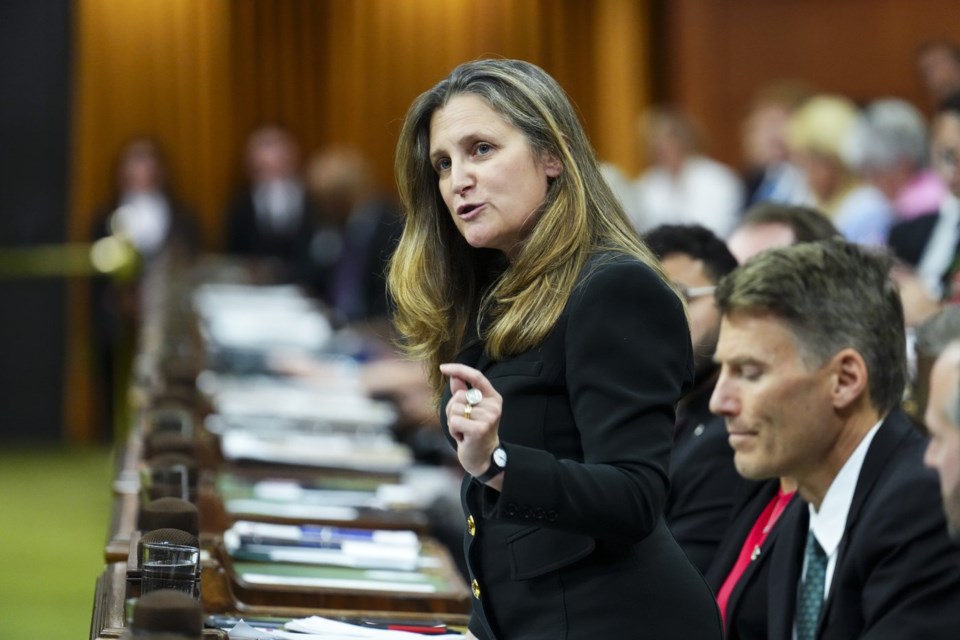
VICTORIA — Canada's transport minister says she is "dismayed" BC Ferries contracted a Chinese state-owned shipyard to build four new vessels in the current geopolitical context that includes "unjustified" tariffs on Canada.
Canada Transport Minister Freeland 'dismayed' by BC Ferries deal with Chinese company YahooView Full Coverage on Google News

The Coward's Bargain: How We Taught A Generation To Live In Fear Authored by Josh Stylman via Substack,Everyone's Afraid to SpeakSomeone our family has known forever recently told my sister that they've been reading my Substack and that if they wrote the things I write, people would call them crazy. I got a kick out of that—not because it's untrue, but because it reveals something darker about where we've ended up as a society. Most people are terrified of being themselves in public.My sister’s response made me laugh: "People do call him crazy. He simply doesn't care.” The funniest part is that I don't even write the craziest stuff I research—just the stuff I can back up with sources and/or my own personal observations. I always try to stay rooted in logic, reason and facts though—I'm clear when I'm speculating and when I'm not.This same guy has sent me dozens of private messages over the last 4 or 5 years challenging me on stuff I share online. I'll respond with source material or common sense, and then—crickets. He disappears. If I say something he doesn’t want to hear, he vanishes like a child covering his ears. Over the last few years, I’ve been proven right about most of what we’ve argued about, and he’s been wrong. But it doesn’t matter—he’s got the memory of a gnat and the pattern never changes.But he'd never make that challenge publicly, never risk being seen engaging with my arguments where others might witness the conversation. This kind of private curiosity paired with public silence is everywhere—people will engage with dangerous ideas in private but never risk being associated with them publicly. It's part of that reflexive "that can't be true" mindset that shuts down inquiry before it can even begin.But he's not alone. We've created a culture where wrongthink is policed so aggressively that even successful, powerful people whisper their doubts like they're confessing crimes.I was on a hike last year with a very prominent tech VC. He was telling me about his son's football team—how their practices kept getting disrupted because their usual field on Randall's Island was now being used to house migrants. He leaned in, almost whispering: "You know, I'm a liberal, but maybe the people complaining about immigration have a point." Here's a guy who invests mountains of money into companies that shape the world we live in, and he's afraid to voice a mild concern about policy in broad daylight. Afraid of his own thoughts.After I spoke out against vaccine mandates, a coworker told me he totally agreed with my position—but he was angry that I'd said it. When the company didn't want to take a stand, I told them I would speak as an individual—on my own time, as a private citizen. He was pissed anyway. In fact, he was scolding me about the repercussions to the company. What's maddening is that this same person had enthusiastically supported the business taking public stands on other, more politically fashionable causes over the years. Apparently, using your corporate voice was noble when it was fashionable. Speaking as a private citizen became dangerous when it wasn’t.Another person told me they agreed with me but wished they were "more successful like me" so they could afford to speak out. They had "too much to lose." The preposterousness of this is staggering. Everyone who spoke out during COVID sacrificed—financially, reputationally, socially. I sacrificed plenty myself.But I'm no victim. Far from it. Since I was a young man, I've never measured achievement by finance or status—my benchmark for being a so-called successful person was owning my own time. Ironically, getting myself canceled was actually a springboard to that. For the first time in my life, I felt I'd achieved time ownership. Whatever I’ve achieved came from being raised by loving parents, working hard, and having the spine to follow convictions rationally. Those attributes, coupled with some great fortune, are the reason for whatever success I've had—they're not the reason I can speak now. Maybe this person should do some inward searching about why they're not more established. Maybe it's not about status at all. Maybe it's about integrity.This is the adult world we've built—one where courage is so rare that people mistake it for privilege, where speaking your mind is seen as a luxury only the privileged can afford, rather than a fundamental requirement for actually becoming established.And this is the world we're handing to our children.We Built the Surveillance State for ThemI remember twenty years ago, my best friend's wife (who's also a dear friend) was about to hire someone when she decided to check the candidate's Facebook first. The woman had posted: “Meeting the whores at [company name]”—referring to my friend and her coworkers. My friend immediately withdrew the offer. I remember thinking this was absolutely terrible judgment on the candidate's part, however it was dangerous territory we were entering: the notion of living completely in public, where every casual comment becomes permanent evidence.Now that danger has metastasized into something unrecognizable. We've created a world where every stupid thing a fifteen-year-old says gets archived forever. Not just on their own phones, but screenshot and saved by peers who don't understand they're building permanent files on each other—even on platforms like Snapchat that promise everything disappears. We've eliminated the possibility of a private adolescence—and adolescence is supposed to be private, messy, experimental. It's the laboratory where you figure out who you are by trying on terrible ideas and throwing them away.But laboratories require the freedom to fail safely. What we've built instead is a system where every failed experiment becomes evidence in some future trial.Think about the dumbest thing you believed at sixteen. The most embarrassing thing you said at thirteen. Now imagine that moment preserved in high definition, timestamped, and searchable. Imagine it surfacing when you're thirty-five and running for school board, or just trying to move past who you used to be.If there was a record of everything I did when I was sixteen, I would have been unemployable. Come to think of it, I'm way older than that now and I'm unemployable anyway—but the truth still stands. My generation might have been the last to fully enjoy an analog existence as children. We got to be stupid privately, to experiment with ideas without permanent consequences, to grow up without every mistake being archived for future use against us.I remember teachers threatening us with our "permanent record." We laughed—some mysterious file that would follow us forever? Turns out they were just early. Now we've built those records and handed the recording devices to children. Companies like Palantir have turned this surveillance into a sophisticated business model.We're asking children to have adult judgment about consequences they can't possibly understand. A thirteen-year-old posting something stupid isn't thinking about college applications or future careers. They're thinking about right now, today, this moment—which is exactly how thirteen-year-olds are supposed to think. But we've built systems that treat childhood immaturity as a prosecutable offense.The psychological toll is staggering. Imagine being fourteen and knowing that anything you say might be used against you by people you haven't met yet, for reasons you can't anticipate, at some unknown point in the future. That's not adolescence—that's a police state built out of smartphones and social media.The result is a generation that's either paralyzed by self-consciousness or completely reckless because they figure they're already screwed. Some retreat into careful blandness, crafting personas so sanitized they might as well be corporate spokespeople for their own lives. Others go scorched earth—if everything's recorded anyway, why hold back? As my friend Mark likes to say, there's Andrew Tate and then there's a bunch of incels—meaning the young men either become performatively brash and ridiculous, or they retreat entirely. The young women seem to either drift toward fearful conformity or embrace monetized exposure on platforms like OnlyFans. We’ve managed to channel an entire generation’s rebellion into the very systems designed to exploit them.The COVID Conformity TestThis is how totalitarian thinking takes root—not through jackbooted thugs, but through a million small acts of self-censorship. When a venture capitalist whispers his concerns about immigration policy like he's confessing to a thought crime. When successful professionals agree with dissenting views privately but would never defend them publicly. When speaking obvious truths becomes an act of courage rather than basic citizenship.Orwell understood this perfectly. In 1984, the Party's greatest achievement wasn't forcing people to say things they didn't believe—it was making them afraid to believe things they weren't supposed to say. "The Party seeks power entirely for its own sake," O'Brien explains to Winston. "We are not interested in the good of others; we are interested solely in power." But the real genius was making citizens complicit in their own oppression, turning everyone into both prisoner and guard.History shows us how this works in practice. The Stasi in East Germany didn't just rely on secret police—they turned ordinary citizens into informants. By some estimates, one in seven East Germans was reporting on their neighbors, friends, even family members. The state didn't need to watch everyone; they got people to watch each other. But the Stasi had limitations: they could recruit informants, but they couldn't monitor everyone simultaneously, and they couldn't instantly broadcast transgressions to entire communities for real-time judgment.Social media solved both problems. Now we have total surveillance capability—every comment, photo, like, and share automatically recorded and searchable. We have instant mass distribution—one screenshot reaching thousands in minutes. We have volunteer enforcement—people eagerly participating in calling out "wrongthink" because it feels righteous. And we have permanent records—unlike Stasi files locked in archives, digital mistakes follow you forever.The psychological impact is exponentially worse because Stasi informants at least had to make a conscious choice to report someone. Now the reporting happens automatically—the infrastructure is always listening, always recording, always ready to be weaponized by anyone with a grudge or a cause.We saw this machinery in full operation during COVID. Remember how quickly "two weeks to flatten the curve" became orthodoxy? How questioning lockdowns, mask mandates, or vaccine efficacy wasn't just wrong—it was dangerous? How saying "maybe we should consider the trade-offs of closing schools" could get you labeled a grandma-killer? The speed at which dissent became heresy was breathtaking.History has shown us governments can be terrible to citizens. The hardest pill to swallow was the horizontal policing. Your neighbors, coworkers, friends, and family members became the enforcement mechanism. People didn't just comply; they competed—virtue-signaling their way into a collective delusion where asking basic questions about cost-benefit analysis became evidence of moral deficiency. Neighbors called police on neighbors for having too many people over. People photographed "violations" and posted them online for mass judgment.And the most insidious part? The people doing the policing genuinely believed they were the good guys. They thought they were protecting society from dangerous misinformation, not realizing they had become the misinformation—that they were actively suppressing the kind of open inquiry that's supposed to be the foundation of both science and democracy.The Ministry of Truth didn't need to rewrite history in real time. Facebook and Twitter did it for them, memory-holing inconvenient posts and banning users who dared to share pre-approved scientific studies that happened to reach unapproved conclusions. The Party didn't need to control the past—they just needed to control what you were allowed to remember about it.This wasn't an accident or an overreaction. This was a stress test of how quickly a free society could be transformed into something unrecognizable, and we failed spectacularly. Anyone who actually followed the science understood the only pandemic was one of cowardice. Worse, most people didn't even notice we were being tested. They thought they were just "following the science"—never mind that the data kept changing to match the politics, or that questioning anything had somehow become heretical.The beautiful thing about this system is that it's self-sustaining. Once you've participated in the mob mentality, once you've policed your neighbors and canceled your friends and stayed silent when you should have spoken up, you become invested in maintaining the fiction that you were right all along. Admitting you were wrong isn't just embarrassing—it's an admission that you participated in something monstrous. So instead, you double down. You disappear when confronted with inconvenient facts.Raising PrisonersAnd this brings us back to the children. They're watching all of this. But more than that—they're growing up inside this surveillance infrastructure from birth. The Stasi's victims at least had some years of normal psychological development before the surveillance state kicked in. These kids never get that. They're born into a world where every thought might be public, every mistake permanent, every unpopular opinion potentially life-destroying.The psychological impact is devastating. Research shows that children who grow up under constant surveillance—even well-meaning parental surveillance—show higher rates of anxiety, depression, and what psychologists call "learned helplessness." They never develop internal locus of control because they never get to make real choices with real consequences. But this goes far deeper than helicopter parenting.The ability to hold unpopular opinions, to think through problems independently, to risk being wrong—these aren't just nice-to-haves. They're core to psychological maturity. When you eliminate those possibilities, you don't just get more compliant people; you get people who literally can't think for themselves anymore. They outsource their judgment to the crowd because they never developed their own.We're creating a generation of psychological cripples—people who are practiced at reading social cues and adjusting their thoughts accordingly, but who have never learned to form independent judgments. People who mistake consensus for truth and popularity for virtue. People who have been so thoroughly trained to avoid wrong-think that they've either lost—or never developed—the capacity for original thought entirely.But here's what's most disturbing: the kids are learning this behavior from us. They're watching adults who whisper their real thoughts, who agree privately but stay silent publicly, who confuse strategic silence with wisdom. They're learning that authenticity is dangerous, that having real convictions is a luxury they can't afford. They're learning that truth is negotiable, that principles are disposable, and that the most important skill in life is reading the room and adjusting your thoughts accordingly.The feedback loop is complete: adults model cowardice, children learn that genuine expression is risky, and everyone becomes practiced at self-censorship rather than self-examination. We've created a society where the Overton window isn't just narrow—it's actively policed by people who are terrified of stepping outside it, even when they privately disagree with its boundaries.This is the architecture of soft totalitarianism. Just the constant, gnawing fear that saying the wrong thing—or even thinking it too loudly—will result in social death. The beauty of this system is that it makes everyone complicit. Everyone has something to lose, so everyone stays quiet. Everyone remembers what happened to the last person who spoke up, so nobody wants to be next.The technology doesn't just enable this tyranny; it makes it psychologically inevitable. When the infrastructure punishes independent thinking before it can fully form, you get psychological arrested development on a mass scale.It’s already baked into education and employment through DEI and ESG. Wait till it's baked into the monetary system. Maybe they're just connecting us to the Borg anyway?We're passing this pathology down to our children like a genetic disorder. Except this disorder isn't inherited—it's enforced. And unlike genetic disorders, this one serves a purpose: it creates a population that's easy to control, easy to manipulate, easy to lead around by the nose as long as you control the social rewards and punishments.The Price of TruthI don't share my opinions because I "get away with it"—I don't get away with anything. I've paid socially, professionally, and even financially. But I do it anyway because the alternative is spiritual death. The alternative is becoming someone who messages critics privately but never takes a public stand, someone who's perpetually annoyed by others' courage but never exercises their own.The difference isn't ability or privilege. It's willingness. I'm open-minded and open-hearted. I can be convinced of anything—but show me, don't tell me. I'm willing to be wrong, willing to change my mind when new information comes to light or I gain a different perspective on an idea, willing to defend ideas I believe in even when it's uncomfortable.There are a lot of us right now realizing something isn't right—that we've been lied to about everything. We're trying to make sense of what we're seeing, asking uncomfortable questions, connecting dots that don't want to be connected. When we call that out, the last thing we need is people who haven't done the work standing in our way, carrying water for the establishment forces that are manipulating them.Most people could do the same thing if they chose to—they just don't choose to because they've been trained to see conviction as dangerous and conformity as safe.A 2020 Cato Institute survey found that 62% of Americans say the political climate prevents them from sharing their political beliefs because others might find them offensive. Majorities of Democrats (52%), independents (59%), and Republicans (77%) all agree they have political opinions they are afraid to share.When adults who lived through COVID saw what happens when groupthink becomes gospel—how quickly independent thought gets labeled dangerous, how thoroughly dissent gets suppressed—many responded not by becoming more committed to free expression, but by becoming more careful about what they express. They learned the wrong lesson.What we're creating is a society where authenticity has become a radical act, where courage is so rare it looks like privilege. We're raising children who learn that being yourself is dangerous, that having real opinions carries unlimited downside risk. They're not just careful about what they say—they're careful about what they think.This doesn't create better people. It creates more fearful people. People who mistake surveillance for safety, conformity for virtue, and silence for wisdom. People who've forgotten that the point of having thoughts is sometimes to share them, that the point of having convictions is sometimes to defend them.The solution isn't to abandon technology or retreat into digital monasteries. But we need to create spaces—legal, social, psychological—where both kids and adults can fail safely. Where mistakes don't become permanent tattoos. Where changing your mind is seen as growth rather than hypocrisy. Where having convictions is valued over having clean records.Most importantly, we need adults who are willing to model courage instead of strategic silence—who understand that the price of speaking up is usually less than the price of staying quiet. In a world where everyone's afraid to say what they think, the honest voice doesn't just stand out—it stands up.Because right now, we're not just living in fear—we're teaching our children that fear is the price of participation in society. And a society built on fear isn't a society at all. It's just a more comfortable prison, one where the guards are ourselves and the keys are our own convictions, which we've learned to keep safely locked away.Whether it's experimental medicine or the masters of war lying again to drag us into what might become World War III—it's PSYOP season—it's never been more important that people find their conviction, use their voice, and become a force for good. If you're still scared to push back against war propaganda, still getting swept up in manufactured outrage cycles, still choosing your principles based on which team is in power—then you may have learned absolutely nothing from the last few years.These days, friends are starting to confide in me that maybe I was right about the mRNA vaccines not working. I don't gloat—in fact, I appreciate the openness. But my standard reply is that they're four years late to the story. They'll know they've caught up when they realize the world is run by a bunch of satanic pedophiles. And yeah, I used to think that sounded crazy too. Tyler DurdenFri, 06/20/2025 - 21:45

Spreading a manufacturing base all over the region BYD has aggressively expanded its footprint across the Southeast Asian (ASEAN) region, strategically establishing distributorships in several key countries. This expansion is often facilitated through partnerships with prominent local automotive or business conglomerates, a tactic that mirrors the successful market entry strategies ... [continued]The post BYD Set to Dominate NEV Market in Southeast Asia, Starting with Thailand appeared first on CleanTechnica.

Omnicom Network Achieves Record Number of Wins in 76-Year History Under Recently Appointed Global Leadership CANNES, France, June 20, 2025 /PRNewswire/ -- DDB Worldwide, part of Omnicom, has once again claimed the prestigious title of Network of the Year at the 2025 Cannes Lions...

HOUSTON, June 20, 2025 /PRNewswire/ -- Venterra Realty has been recognized by FORTUNE magazine & the Great Place To Work® Institute as one of the Best WorkplacesTM in Texas for an 8th consecutive year. To determine the Fortune Best Workplaces in TexasTM List, Great Place To Work surveyed...

The U.S. Food and Drug Administration (FDA) on Friday approved Regeneron Pharmaceuticals Inc. (NASDAQ:REGN) and Sanofi SA’s (NASDAQ:SNY) Dupixent (dupilumab) for adult patients with bullous pemphigoid (BP), a rare, chronic autoimmune skin disorder.BP primarily affects elderly patients and is characterized by intense itch, painful blisters and lesions, and skin reddening. It can be chronic and relapsing with underlying type 2 inflammation.The blisters and rash can form over much of the body and cause the skin to bleed and break down, making patients more prone to infection.Also Read: Regeneron, Sanofi Stock Falls After ...Full story available on Benzinga.com

The state’s taxes and business climate has turned stormier in recent years, according to a new digital dashboard tool by a Washington-based think tank.

Tariff fatigue is real. Here’s how to save as prices rise and uncertainty grows.

The controversial change will be here before the year ends.
VANCOUVER, British Columbia, June 20, 2025 (GLOBE NEWSWIRE) -- Glacier Media Inc. (TSX:GVC) ("Glacier" or the "Company") reports the voting results of the Annual General Meeting of its shareholders held on June 19, 2025 in Vancouver, British Columbia.The following five nominees were re-elected as directors of the Company by the following votes:NomineeVotes ForPercentVotes AgainstPercentSam Grippo77,972,35595.58%Full story available on Benzinga.com
Travel tech firm Navan confidentially files to go public in US Yahoo FinanceNavan Announces Confidential Submission of Draft Registration Statement Yahoo FinanceNavan files confidentially for U.S. IPO Investing.comNavan to file confidentially for IPO, betting on market reopening CTechTravel tech firm Navan confidentially files for US IPO Reuters

A recent call on “The Ramsey Show” delivered a shocking back-to-back contrast. One caller had just explained how they were surviving on $850 a month. Moments later, a 22-year-old named Zack called in to say he was making between $30,000 and $90,000 a month by day trading futures.From Finance Major To Full-Time TraderZack explained that he studied finance at Lipscomb University in Nashville and started trading with just $3,000. “I decided to use my initial investment for evaluations with a few prop firms,” he said. “You use their capital and get to keep 70 to 90 percent of the profits.”Don't Miss:Maker of the $60,000 foldable home has 3 factory buildings, 600+ houses built, and big plans to solve housing — this is your last chance to become an investor for $0.80 per share.Peter Thiel turned $1,700 into $5 billion—now accredited investors are eyeing this software company with similar breakout potential. Learn how you can invest with $1,000 ...Full story available on Benzinga.com

Crocs (NASDAQ:CROX) has outperformed the market over the past 10 years by 9.94% on an annualized basis producing an average annual return of 20.95%. Currently, Crocs has a market capitalization of $5.62 billion. Buying $100 In CROX: If an ...Full story available on Benzinga.com

On Thursday, Canadian Prime Minister Mark Carney announced sweeping new plans aimed at protecting Canadian metal producers. What Happened: These plans include counter-tariffs on American steel and aluminum if no trade agreement is reached between the two nations before July 21.“We will take the time we need to negotiate the best deal for Canada, but no longer,” Carney said, according to a news release by the Canadian Department of Finance. “In parallel, we are ensuring that workers and industries are protected from the unjust U.S. tariffs.”See Also: Trump Once Said He Made Juneteenth ‘Very Famous’ But Now He’s Unhappy About ‘Too Many’ Non-Working Holidays, Says Its Costing America BillionsThe measures unveiled by Canada’s Finance Minister, François-Philippe Champagne, include a tariff rate quota system capping 2025 steel imports from non-FTA countries at 2024 levels. This is essentially a cap on how much ...Full story available on Benzinga.com

Three people in Glendale were arrested in an operation targeting an alleged luxury car theft ring. FOX 10 Investigator Justin Lum has the details.

U.S. futures slipped Thursday evening stateside. Asia-Pacific markets climbed Friday. Earlier this year, Meta tried to acquire Safe Superintelligence, the artificial intelligence startup launched by OpenAI co-founder Ilya Sutskever, sources said. Japan’s core inflation rate climbed to 3.7% in May, the highest since January 2023 and more than the 3.6% expected by economists polled by Reuters. Shares of Pop Mart, the toymaker behind the smash hit Labubu, continued to tumble Friday as state media criticized the “blind box” concept. Airbus had racked up nearly $21 billion of orders at the Paris Air Show as of Thursday morning, per a Reuters calculation. Since May 3, when Warren Buffett announced his plans to step down as CEO, Berkshire Hathaway stock has lost more than 10%.The conflict between Israel and Iran is intensifying, with both countries not backing down from strikes and their leaders continuing to issue heated rhetoric. The prospect of the United States potentially joining the fray — which Russia warned would cause “a terrible spiral of escalation” — is putting the world on a knife’s edge.That unease is reflected in the markets. While U.S. exchanges were closed Thursday for a holiday, futures retreated in the evening local time. Across the Atlantic, travel and leisure stocks suffered the most as the Middle East conflict cast a shadow over international aviation.At the Paris Air Show, however, aircraft manufacturers are still booking billions in orders. Airbus had secured more than $20 billion in deals as of Thursday, according to Reuters calculations. That said, those encouraging numbers may not reflect immediate optimism about the global economy or geopolitics — aircrafts take years to deliver, and both Airbus and Boeing have a backlog of more than 8,000 and 5,000 aircrafts respectively.Until investors get a clearer sense of whether the U.S. will launch strikes on Iran, markets aren’t likely to find solid ground.— Yeo Boon PingWhat you need to know todayU.S. futures slip after trading reopensU.S. futures slipped Thursday evening stateside. Regular trading in the U.S. was closed for the Juneteenth holiday. While, oil prices for both U.S. crude oil rose, international benchmark Brent fell nearly 3%. Asia-Pacific markets rose Friday. China’s CSI 300 added 0.26% at 1:30 p.m. Singapore time, as the country’s central bank kept its benchmark lending rates unchanged.Meta tried to buy OpenAI co-founder’s startupEarlier this year, Meta tried to acquire Safe Superintelligence, the artificial intelligence startup launched by OpenAI co-founder Ilya Sutskever, according to sources familiar with the matter. Sutskever turned down Meta and its attempt to hire him, the sources said. But Daniel Gross, the startup’s CEO, and former GitHub CEO Nat Friedman will join Meta as part of Mark Zuckerberg’s deal with NFDG, a venture capital firm both men run.Inflation in Japan highest in two yearsRice prices in Japan more than doubled in May, spiking 101.7% year over year and marking their largest increase in over half a century. The surge in rice prices comes as Japan’s annual core inflation rate, which excludes fresh food costs, climbed to 3.7% in May, the highest since January 2023 and more than the 3.6% expected by economists polled by Reuters.Labubu-maker’s shares slumpHong Kong-listed shares of Pop Mart, the toymaker behind the smash hit Labubu, continued to tumble Friday. Pop Mart first gained popularity with its “blind box” concept, a business model criticized by People’s Daily, the Chinese Communist Party’s official newspaper, on Friday. Morgan Stanley said in a note late Wednesday it was replacing Pop Mart with insurance company PICC P&C in the firm’s China and Hong Kong focus list.Airbus stole the show in ParisAirbus dominated the order books at the Paris Air Show. The European aircraft manufacturer had racked up nearly $21 billion of orders as of Thursday morning, per a Reuters calculation. That included 132 firm orders on Monday, from customers including Saudi leasing firm AviLease, Japan’s ANA and Poland’s LOT, versus 41 for Boeing and 15 for Brazil’s Embraer, according to a tally by aviation advisory IBA.[PRO] Berkshire stocks drop without BuffettWarren Buffett once predicted that Berkshire Hathaway stock would rise when he eventually steps down. So far, the opposite has happened. Since May 3, when the “Oracle of Omaha” announced his plans to hand over the reins, Berkshire stock has lost more than 10%, underperforming the S&P 500 by about 15 percentage points. Some think it could fall even more.And finally...Nurphoto | Nurphoto | Getty ImagesA Lenskart shop in Kolkata, India.Is India’s hot IPO market cooling, or is it a blip?Twelve months ago, India’s initial public offering market was booming, with tech startups from food and grocery delivery player Swiggy to electric two-wheeler manufacturer Ola Electric at the cusp of their debut.This year, however, there has been a pronounced change. There have been just 99 listings so far, down from 147 in the same period a year ago, according to FactSet data.Several companies have put their listing plans on hold given weak investor sentiment and the bleak macroeconomic outlook, despite having received approval from the Securities and Exchange Board of India.

Although the Federal Reserve hasn’t changed its benchmark since December, the average credit card interest rate keeps inching higher. In part, card issuers are trying to protect themselves from riskier borrowers.Emirmemedovski | E+ | Getty ImagesEven with the Federal Reserve on the sidelines, credit card rates are edging higher.In June, credit card interest rates rose for the third straight month, hitting the highest level since December, according to a recent report by LendingTree.Now, the average annual percentage rate is just over 20%, according to Bankrate. For new cards, the average APR is up to 24.3%, according to LendingTree.“These are crippling rates that are compounding your debt at such a fast clip,” said certified financial planner Clifford Cornell, an associate financial advisor at Bone Fide Wealth in New York City. Here’s a look at other stories affecting the financial advisor business. 3 key money moves to consider while the Fed keeps interest rates higherThe average 401(k) savings rate hit a record high. See if you’re on trackAmericans believe real estate, gold are the best long-term investmentsCredit card rates stayed stable for years after the introduction of the Credit CARD Act, which passed in 2009, but shot up after the Fed started raising rates in 2015. In the decade since, APRs roughly doubled from 12% to where they stand today.Most credit cards have a variable rate so there’s a direct connection to the Fed’s benchmark.It follows that credit card rates spiked again along with the central bank’s string of 11 rate hikes starting in March 2022.Although the Fed cut its key borrowing rate benchmark three times in 2024 and has held its benchmark steady since December, banks continued to raise credit card interest rates to record levels — and some issuers said they’ll keep those higher rates in place.“This unfortunate trend could continue in coming months,” said Matt Schulz, LendingTree’s chief credit analyst.Why some APRs are still risingCard issuers are mitigating their exposure against borrowers who may fall behind on payments or default, according to Schulz. “This is a sign of banks trying to protest themselves from the risk that is out there in these uncertain times,” he said.But it’s also a two-way street. “When there is uncertainty in the market, this often results in consumers seeking new credit to ensure they are prepared for any future financial hurdles,” said Charlie Wise, senior vice president and head of global research and consulting at TransUnion. That also has the effect of driving issuers to increase APRs.“If more balances in the hands of riskier borrowers, those rates will trend higher,” Wise said.How to avoid sky-high interest chargesOnly consumers who carry a balance from month to month feel the pain of high APRs. And higher APRs only kick in for new loans, not old debts, as in the case of new applicants for credit cards.But for those currently struggling with sky-high interest charges, even an eventual Fed rate cut may not provide much relief.“The reality is you could drop the fed funds rate by two full basis points and all you are doing is lowering your interest rate from 22% to 20%,” Wise said — “that’s not a material difference.”Rather than wait for a rate cut that may be months away, borrowers could switch now to a zero-interest balance transfer credit card or consolidate and pay off high-interest credit cards with a lower-rate personal loan, Schulz advised.“The truth is that people have way more power over the rates they pay than they think they do, especially if they have good credit,” Schulz said.The better your credit, the lower the rate you may get offered for a new card account.Cardholders who pay their balances in full and on time and keep their utilization rate — or the ratio of debt to total credit — below 30% of their available credit, can also benefit from credit card rewards and a higher credit score, experts say. That paves the way to lower-cost loans and better terms going forward.Subscribe to CNBC on YouTube.
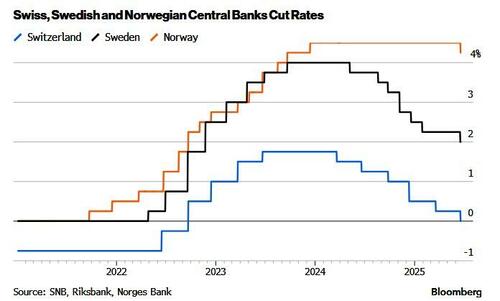
Liquidity Floodgates Open As 3 Central Banks Unexpectedly Cut Rates In Under 24 Hours Trump has repeatedly expressed his displeasure with the ECB cutting rates 8 times since the end of the central bank's hiking cycle one year ago; he certainly won't be happy that three other European central banks joined the easing fray overnight as the global economy once again careens toward the abyss.In the span of less than 24 hours, three rate cuts by three central banks in Europe underscored the dramatic global shift toward policy easing as monetary officials seek to manage "the fallout from Trump’s unpredictable trade policies" as Bloomberg puts it, but really that's just a diversion for the real cause: global economic slowdown now that the last traces of stimulus from the post-covid monetary and fiscal bonanza fade away.Central bankers in Switzerland and Sweden had suggested as recently as March that they were likely done easing, but the Swiss National Bank instead trimmed borrowing costs by 25 basis points on Thursday - and becoming the first major bank to cut rates back to zero (and in some cases, negative) - following a similar move by Sweden’s Riksbank a day earlier. And an easing pivot by Norway, also on Thursday, was altogether more dramatic, with another quarter-point cut that none of the economists surveyed by Bloomberg predicted.With policy decisions from at least 18 central banks managing more than 40% of the global economy scheduled for this week, the easing across much of Europe contrasted with a wait-and-see approach predominating around the world. Also on Thursday, the Bank of England held rates but the much more dovish than expected decision (6-3 voted to keep rates unchanged, while expectations were for a 7-2 split) sent the pound sliding. Meanwhile, the Federal Reserve, and Bank of Japan both held, the first however because it has a political vendetta against Trump...The day is August 27, 2019. Former NY Fed president Bill Dudley writes a Bloomberg oped saying "the Fed shouldn't enable Donald Trump" and urged the central bank not to "provide offsetting stimulus" in Trump's trade war with China.Six years later, here we are pic.twitter.com/H6WT5O0cMD— zerohedge (@zerohedge) April 11, 2025... and the second because it has no idea how to grow rice anymore and the local population has been crushed by surging food prices which somehow a stronger yen is expected to make better. All that comes against the backdrop of a July 9 deadline that could see the US reintroduce punitive trade tariffs across the world. Combined with continued uncertainty over the war in Ukraine and a potential US strike on Iran, it’s left some policymakers unwilling or unable to move.Meanwhile, the reasons for the rate cuts in Sweden, Norway and Switzerland are all linked to inflation, even if the situations diverge.Swiss consumer prices fell 0.1% from a year ago in May and new SNB forecasts published Thursday show inflation will average just 0.2% this year. That’s primarily due to the haven franc, which has appreciated against the dollar and euro since Trump took office.Price pressure in Sweden, whose currency has soared against the dollar in 2025, has eased after a temporary spike at the start of the year and as a nascent rebound in the largest Nordic nation has fizzled out. That’s allowing space for more stimulus, Riksbank Governor Erik Thedeen said Wednesday.The krona has been the best performer this year in the G-10 of major currency holders, surging 15% against the dollar, and also helping to reduce the risk of imported inflation.In Norway, price growth has been stickier over the last year, partly due to a weaker performance of the krone. Even so, the local core CPI last month matched this year’s lowest level, at 2.8%. The Norwegian central bank now sees headline price growth next year at 2.2%, down from 2.7% seen in March, while this year’s inflation is still seen at 3%.The three institutions are also at very different stages in their policy paths: Norway’s Thursday move is its first post-pandemic reduction in borrowing costs, while Sweden and Switzerland carried out their seventh and six moves respectively. Uniting them, however, is the fact that they all may cut again. Riksbank’s Thedeen and Norges Bank Governor Ida Wolden Bache both told reporters as much, while SNB President Martin Schlegel wouldn’t exclude such an option, even if that would push the Swiss rate into negative territory.Which again begs the question: just how deflationary are tariffs anyway? Tyler DurdenThu, 06/19/2025 - 22:25

Forge Resources (CSE: FRG; OTCQB: FRGGF) has reported two occurrences of visible gold in ALT-25-009 and has confirmed continued porphyry-style mineralization, veining, [...]The post Forge Resources reports visible gold and continued mineralization at Alotta appeared first on Canadian Mining Journal.
IDEX Biometrics ASA (“IDEX”) discloses the following on behalf of a shareholder.

President Donald Trump criticized the growing number of federal holidays and their economic cost in a post on Truth Social. Notably, his comments came on the Juneteenth holiday.What Happened: Trump took to his platform to air his frustrations about federal holidays. The president, however, did not post any message commemorating the holiday associated with the emancipation of enslaved African Americans.“Too many non-working holidays in America,” he posted, adding, “It is costing our Country $BILLIONS OF DOLLARS to keep all of these businesses closed. The workers don't want it either!”“It must change if we are going to, MAKE ...Full story available on Benzinga.com
Stocks struggle, oil up for 3rd week as Trump weighs US action on Iran ReutersAmerica’s economy could face a war shock CNNOil Set for Third Weekly Advance as Trump Considers Iran Strike BloombergOil Prices Are Jumping. What History Says Happens When Conflicts Threaten Supply. Barron'sBrent futures down nearly $2 after U.S. delays decision on direct Iran involvement CNBC
IDEX Biometrics ASA (“IDEX”) discloses the following on behalf of a shareholder.
Estee Lauder mogul Leonard Lauder remembered by family, friends as ‘larger than life’ during NYC service Page SixLeonard Lauder, a Consummate New Yorker The New York TimesLeonard Lauder, visionary beauty brand builder, 1933-2025 Financial TimesLeonard Lauder: Son of Estée Lauder, who took the brand global, dies aged 92 BBCLeonard Lauder, who gifted millions to Maine causes, dies at 92 The Portland Press Herald
Guelph man plans retirement boost after lottery win Guelph News‘Being a winner is a very nice feeling’: Guelph man wins $50k with Instant scratch ticket Guelph Mercury‘Paying off car’ first on list for $50,000 Ontario lottery winner INsauga

Siemens Energy India Ltd (NSE: ENRIN) extended its post-listing weakness on Thursday, slipping to ₹2,735 in early trade. The stock has now dropped nearly 8.5% from its debut high near ₹2,990, as investors take a breather following the buzz around its recent demerger from Siemens Ltd. Despite a strong initial listing, the stock has struggled to hold its ground. Traders booked quick profits within the first session, and the momentum hasn’t recovered since. The selloff comes amid a lack of [...]The post Siemens Energy India Drops 8.5% After Listing, Should You Buy the Dip or Wait It Out? appeared first in UK on InvestingCube.

The CEO has responded to a startling trend in workplaces nationwide.

Michigan AG Nessel challenges DOE's order to keep an aging coal plant open, citing financial burden and lack of a true emergency.

TD Synnex (NYSE:SNX) has outperformed the market over the past 15 years by 3.99% on an annualized basis producing an average annual return of 16.08%. Currently, TD Synnex has a market capitalization of $10.37 billion. Buying $1000 In SNX: If ...Full story available on Benzinga.com

Startups don’t build themselves. The Builders Stage at TechCrunch Disrupt 2025, taking place October 27–29 at San Francisco’s Moscone West, is where investors, operators, and founders come to talk tactics — the nitty-gritty of getting something off the ground and making it work. This year, we’re bringing some of the sharpest minds in the game [...]
The United States Postal Service, the Missoulian's primary delivery source for print products, is closed Thursday to recognize Juneteenth, a federal holiday.

A major manufacturing project in Mount Airy is moving a step closer to reality with an official groundbreaking ceremony this week for a new NCFI Polyurethanes plant at Westwood Industrial Park.

US Asked Ukraine Not To Attack Russian Energy, Zelensky Complains Via The Libertarian InstituteUkrainian President Volodymyr Zelensky claimed that he was told by the US not to attack Russian energy infrastructure shortly after Vladimir Putin spoke with President Donald Trump."Today, the Russians launched a stone-cold, combined attack on our energy infrastructure. This is a spit in the face of everything the international community is trying to do to stop this war," the Ukrainian leader said Sunday. "It happened right after Putin’s conversation with Trump. After the Americans asked us not to strike Russian energy facilities."Zelensky went on to attack Putin for offering to play a mediating role to end Israel’s war on Iran."At the same time as Putin tries to portray himself as a mediator for the Middle East and attempts to somehow assist his accomplices in Tehran. The level of cynicism is staggering," he added.The Libertarian Institute reached out to the State Department to confirm Zelensky’s statement. The department’s press office replied:"The United States and Ukraine agreed to develop measures for implementing President Trump’s and President Zelenskyy’s agreement to ban strikes against energy facilities of Russia and Ukraine," and referred to a March joint statement issued by the US and Ukraine.Ukraine’s First Deputy Prime Minister Yulia Svyrydenko said that Kiev had been told not to attack Russian energy infrastructure, but did not say the message came from Washington."Some allies have asked us not to strike Russian energy infrastructure – even as Russia wages all-out war on ours: targeting power plants, oil and gas infrastructure, hydroelectric dams – every form of energy we rely upon," she said.Throughout the war, Ukraine has stepped up attacks inside of Russia, including hitting energy targets. The Kyiv Insider says Ukrainian forces did halt attacks on Russian energy in the 45 days leading up the the Presidential election last November, but resumed those attacks on election day in the US. Tyler DurdenThu, 06/19/2025 - 10:45

TORONTO, June 19, 2025 /PRNewswire/ - Equitable Bank (the "Bank" or "Equitable"), Canada's Challenger BankTM, is pleased to announce that it has completed its latest offering of €500 million (CAD $789 million) of covered bonds (the "bonds"). The bonds were issued under the Bank's CAD $3.0 billion Global Legislative Covered Bond Programme (the "program") and represent Equitable's sixth covered bond issuance since the launch of the program in 2021. "We are pleased to see continued investor support for Equitable Bank's covered bond program. This program is a key part of our broader funding diversification strategy, enabling us to execute on our mission to drive change in Canadian banking to ...Full story available on Benzinga.com

Marcella Chow from JP Morgan Asset Management shares her investment ideas amid slowing U.S. growth, worsening tensions in the Middle East and the push to up defense spending in Europe.
NEW ORLEANS, June 18, 2025 (GLOBE NEWSWIRE) -- ClaimsFiler, a FREE shareholder information service, reminds investors that they have until July 8, 2025 to file lead plaintiff applications in a securities class action lawsuit against Compass Diversified Holdings (NYSE:CODI), if they purchased the Company's securities between May 1, 2024 and May 7, 2025, inclusive (the "Class Period"). This action is pending in the United States District Court for the Central District of California.Get HelpCompass Diversified investors should visit us at https://claimsfiler.com/cases/nyse-codi/ or call toll-free (844) 367-9658. Lawyers at Kahn Swick & Foti, LLC are available to discuss your legal options.About the LawsuitCompass and certain of its executives are charged with failing ...Full story available on Benzinga.com
Ever notice how social media just keeps changing? It seems like every other week there’s something new. Well,...The post How AR Social Media is Redefining Digital Interaction appeared first on TechAnnouncer.

As tensions continue to flare in the Middle East, U.S. Stock futures inch lower on Wednesday evening, compounded by the Fed’s decision to hold rates steady, while warning of lower economic growth and persistent inflation.The S&P 500 Futures are down 0.32%, trading at 6,014.75, followed by Nasdaq Futures at 21,840.50, down 0.48%, and finally Dow Futures, trading at 42,398.00, down 0.27%, at the time of writing this.This comes amid a Situation Room meeting held in the White House on Wednesday to discuss the ongoing conflict between Iran and Israel. It is still unclear what was discussed during the meeting or who was in attendance, according to a report by NBC News. See Also: Full story available on Benzinga.com

Washington Should Stay Out Of Israel's New War Authored by Alexander Langlois via RealClearPolitics,Israel conducted an unprecedented attack on Iranian leadership, its military, and its nuclear program in the early hours of June 13, leaving the region on edge regarding a war many have rightly worked to avoid over decades. The operation raises more questions than answers, further highlighting the only rational path for U.S. policymakers: avoiding a direct war with the Islamic Republic. Israeli officials claim to have hit over 300 targets across Iran via airstrikes, drones, and numerous clandestine operations within the country. Those targets include major Iranian nuclear facilities like the Natanz enrichment site, multiple nuclear scientists, and leading figures in the Iranian government and military. Israel announced that military operations will last multiple days. Reports suggest that Israel assassinated the head of the powerful Islamic Revolutionary Guards Corps (IRGC) Hossein Salami, Chief of Staff of the general command Ali Bagheri, and additional general command officers. Ali Shamkhani, direct aid to Supreme Leader Ayatollah Ali Khamenei, also died from his injuries. Ironically, Washington continued to call on Tehran to attend scheduled nuclear negotiations. U.S. President Donald Trump boasted about his apparent knowledge of the Israeli operation – reminding the Islamic Republic of a credible use of force. Iranian officials called off the talks. Tehran opted to launch multiple waves of attacks at Israel in what could become a dangerous escalatory spiral. Whether or not U.S.-Iran nuclear negotiations continue or restart remains to be seen. Trump is wise to publicly push diplomacy amid an incredibly unstable and unpredictable situation, but he is doing so in a way that directly ties Washington to Tel Aviv’s attack. Worse, it poisons the well from the beginning, highlighting to an already skeptical Tehran that this administration cannot be trusted. That dynamic is why any decision to latch onto Israel at this moment is ultimately foolish. Time and again, Iran has proven that it associates Israeli and U.S. military actions against it as one in the same. Reinforcing that conclusion puts U.S. troops in harm’s way and risks drawing Washington into a conflict with Tehran – the opposite of a core U.S. national interest. It also contradicts the U.S. public, who for years have rejected new Middle East wars. Some experts argue that Tehran is disinterested in a wider conflict it knows it will lose. While that is certainly a possibility given Iranian officials care first and foremost about regime survival, it is not rooted in guarantees. Rather, it risks misinterpreting the Islamic Republic’s aggressive behavior – particularly when attacked or faced with existential threats. That reality is particularly important when considering the personal dynamics at play among Iranian leadership. Iran’s senior leaders have together held prominent positions for decades, going back to the 1979 revolution and its defining 1980s war with Iraq – the latter of which impressed a siege mentality upon much of Iranian society. Officials should be concerned about personal dynamics and past traumas coming to the fore given Israel’s ongoing threat and Iran’s losses, as the assassination of former IRGC-Quds Force head Qassem Soleimani highlights. Ultimately, U.S. officials must consider the risks associated with these unknowns, especially given Washington’s close relationship with Israel. Government handles a portfolio of risk, in which citizen security is paramount. Risking U.S. lives on a hunch that Iran will target them, all backed by a supposed partner’s unprecedented military operations this administration seems disinterested in reigning in, is extremely poor management of that risk. In this regard, it is critical to highlight that the United States cannot be “drawn into” a conflict that it has already participated in for years. Israel’s strikes on Iran are the direct result of U.S. backing – diplomatically and militarily – which lowered Israeli perceptions of costs and perceived risks of an assault on a country substantially larger than itself. This constitutes a classic moral hazard common across U.S. bilateral relationships with partner states in the region. Herein lies the key to preventing a broader conflict – a real possibility should both parties continue to climb the escalatory ladder. Just as Washington has the capacity to embolden Tel Aviv, it also has the influence to hold it back. The Trump administration failed to properly restrain Israeli Prime Minister Benjamin Netanyahu – a political choice shared with former president Joe Biden and numerous previous administrations. But it can still right the ship. Trump must not join this conflict. His administration should not lean into escalatory rhetoric. It must not empower Israel to continue its attacks on Iran – effectively the latest iteration of the already-failed “maximum pressure” strategy of Trump’s first term.The alternative to any of these actions only associates Washington ever more closely to the belligerent of a conflict, in which the other party – Iran – views the United States and Israel as the same enemy. That is the opposite of a supposed peace presidency, gambling U.S. lives and risking a disastrous war.Alexander Langlois is a Contributing Fellow at Defense Priorities. Tyler DurdenWed, 06/18/2025 - 22:35

A Chinese entrepreneur raked in $7.65 million after streaming using an interactive digital avatar. That was more than what he earned from his previous livestream, which he hosted personally. “This is a DeepSeek moment for China’s entire livestreaming and digital human industry,” an analyst said.BEIJING — Avatars generated by artificial intelligence are now able to sell more than real people can, according to a collaboration between Chinese tech company Baidu and a popular livestreamer.Luo Yonghao, one of China’s earliest and most popular livestreamers, and his co-host Xiao Mu both used digital versions of themselves to interact with viewers in real time for well over six hours on Sunday on Baidu’s e-commerce livestreaming platform “Youxuan”, the Chinese tech company said. The session raked in 55 million yuan ($7.65 million).In comparison, Luo’s first livestream attempt on Youxuan last month, which lasted just over four hours, saw fewer orders for consumer electronics, food and other key products, Baidu said.Luo said that it was his first time using virtual human technology to sell products through livestreaming.“The digital human effect has scared me ... I’m a bit dazed,” he told his 1.7 million followers on social media platform Weibo, according to a CNBC translation.Luo started livestreaming in April 2020 on ByteDance’s short video app Douyin, in an attempt to pay off debts racked up by his struggling smartphone company Smartisan. His “Be Friends” Douyin livestream account has nearly 24.7 million followers.Luo’s and his co-host’s avatars were built using Baidu’s generative AI model, which learned from five years’ worth of videos to mimic their jokes and style, Wu Jialu, head of research at Luo’s other company, Be Friends Holding, told CNBC on Wednesday.“This is a DeepSeek moment for China’s entire livestreaming and digital human industry,” Wu said in Mandarin, translated by CNBC. DeepSeek, China’s version of OpenAI, rattled global investors in January with its claims of rivaling ChatGPT at far lower costs and using an open-source approach.AI avatars can sharply reduce costs since companies don’t need to hire a large production team or a studio to livestream. The digital avatars can also stream nonstop without needing breaks.“We have always been skeptical about digital people livestreaming,” Wu said, noting the company had tried out various kinds of digital humans over the years.But he said that Baidu now offers the best digital human product currently available, compared to the early days of livestreaming e-commerce five or six years ago.A growing industryLivestream shopping took off in China after the pandemic forced businesses to find alternative sales channels. More people are turning to livestreaming to earn money from commissions and virtual gifts amid slower economic growth.Livestreaming generated so many sales on Douyin last year that the app surpassed traditional e-commerce company JD.com to become China’s second-largest e-commerce platform — and ate into the market share of lead player Alibaba, according to a report from Worldpanel and Bain & Company last week. Both JD.com and Alibaba’s Taobao also offer livestreaming sales portals.Meanwhile, other Chinese companies, including tech giant Tencent, have developed tools to create digital people that can be used as news anchors. In late 2023, several businesses started trying out virtual human livestreamers during the Singles Day shopping holiday.But analysts have cautioned that products sold via livestreams tend to have a high return rate as they are often impulse purchases.The biggest challenge for using virtual humans to livestream is no longer the technology, but compliance and platform requirements, Wu said. Digital humans need to be trained to adhere to regulations about product advertising, while major livestreaming platforms may have different rules about allowing virtual people to host the sessions, he said.For example, Douyin has rolled out restrictions on using the technology, especially if the virtual people do not interact with viewers.While Luo’s next virtual human appearance hasn’t been set yet, Wu said he expects it will be very soon. And in the future, he said, digital humans could easily livestream in multiple languages to reach users outside China.
Juju Chang Hosted and Martha Teichner Received Lifetime Achievement Award at Cipriani 42nd Street

Marine insurers are now charging 0.2% of the value of a ship for journeys into the Gulf, according to data from insurance broker Marsh McLennan, up from 0.125%. There has also been an uptick in war risk insurance rates for the Red Sea, Marsh said, while cover relating to ports in Israel has more than tripled to 0.7%. The scramble to reassess shipping insurance costs reflects the deteriorating security environment in the Middle East.Israel and Iran’s escalating conflict has significantly driven up the cost of insurance for ships sailing through the Red Sea and Persian Gulf.Marine insurers are now charging 0.2% of the value of a ship for journeys into the Gulf, according to data from the world’s largest insurance broker Marsh McLennan, up from 0.125% prior to Israel’s surprise attack on Iran last week.There has also been an uptick in war risk insurance rates for the Red Sea, Marsh said, while cover relating to ports in Israel has more than tripled to 0.7%.The length of time quotes are valid for has been cut to 24 hours from most leaders, Marsh said, down from 48 hours previously.The scramble to reassess shipping insurance costs reflects the deteriorating security environment in the Middle East, with Israel and Iran continuing to exchange fresh air attacks over recent days.The conflict between the two powers has ratcheted up concerns of a broader conflict, with many closely monitoring the prospect of U.S. intervention.“Given that the situation is currently contained within the region, risks are still being placed to enable cargo to flow through these areas,” Marcus Baker, global head of marine, cargo and logistics at Marsh, told CNBC by email.Read moreIsraeli president denies pursuing regime change in Iran — goal is to ‘remove’ nuclear programOil analysts left scratching their heads over Israel-Iran conflict: ‘Your guess is as good as mine’Shipping groups starting to shy away from the Strait of Hormuz as Israel-Iran conflict ragesSome shipowners have recently opted to steer clear of the strategically important Strait of Hormuz, reaffirming a sense of industry unease amid the conflict.Jakob Larsen, head of security at Bimco, which represents global shipowners, said earlier this week that the escalating conflict was causing concerns in the shipowner community and prompting a “modest drop” in the number of ships sailing through the area.Situated between Iran and Oman, the Strait of Hormuz is a narrow waterway that connects the Persian Gulf to the Arabian Sea. It is recognized as one of the world’s most important oil chokepoints.The inability of oil to traverse through the Strait of Hormuz, even temporarily, can ratchet up global energy prices, raise shipping costs and create significant supply delays.
Texas Instruments to make 'historic' $60bn US chip investment BBCTexas Instruments to invest more than $60 billion to make semiconductors in the US CNNTexas Instruments Stock (TXN) Jumps on U.S. Manufacturing Plans TipRanksTexas Instruments announces two new chip plants in the U.S. AxiosTexas Instruments Updates $60 Billion U.S. Fab Investment Plans EE Times

The wait for a turnaround in Nike Inc's (NYSE:NKE) business is not over, as analysts expect trends to remain challenging in the near term.The Nike Analyst: Analyst Tom Nikic maintained a Buy rating, while reducing the price target from $75 to $66.The Nike Thesis: While there is modest upside to the company's fourth-quarter earnings, it is due to conservative guidance, Nikic said in the note.Check out other analyst stock ratings.Street expectations for Nike's ...Full story available on Benzinga.com

Scholar Rock (NASDAQ:SRRK) revealed results on Wednesday from the Phase 2 EMBRAZE proof-of-concept trial assessing apitegromab in combination with tirzepatide to preserve lean mass during tirzepatide-induced weight loss.Tirzepatide is an active ingredient in Eli Lilly And Co’s (NYSE:LLY) widely used Mounjaro and Zepbound for diabetes and weight loss, respectively.The trial demonstrated that 30% of the total weight loss with tirzepatide alone was due to lean mass loss.Apitegromab therapy (10 mg/kg) with tripeptide preserved an additional 4.2 pounds (1.9 kilograms) or 54.9% (p=0.001) of lean mass compared to tripeptide alone, leading to higher-quality weight loss.Also Read: Full story available on Benzinga.com

Millions of workers now rely on ChatGPT and other AI tools to edit emails, explain financial concepts, write reports, and even generate code. But as this quiet revolution reshapes how we work, it also raises serious questions: Are we sharing...

Credits, benefits enhance year-round programs that aid customersHOLMDEL, N.J., June 18, 2025 /PRNewswire/ -- Jersey Central Power & Light (JCP&L), a subsidiary of FirstEnergy Corp. (NYSE:FE), has received approval from the New Jersey Board of Public Utilities (BPU) to implement measures that will help ease the impact of rising electricity prices on families. Doug Mokoid, FirstEnergy's President of New Jersey: "Electricity supply costs, which are nearly 60% of a family's bill in our service territory, have surged this summer. While we don't control supply prices, we are committed to helping customers manage these increases through new and expanded assistance programs."To help offset higher summer costs, JCP&L will apply a $30 ...Full story available on Benzinga.com
Airline Passenger's Violent Meltdown, Fight in Aisle Caught on Video TMZ

Innoviz Technologies Ltd (NASDAQ:INVZ) shares are moving higher Wednesday. The company announced a partnership with AIoT and robotics cloud platform company Cogniteam.What To Know: Innoviz announced a collaboration with Cogniteam that aims to provide turnkey observation solutions for a range of safety and security applications using InnovizSMART long-range lidar (light detection and ranging).Innoviz’s lidar system will be integrated with Cogniteam’s AI-powered analytics to offer a solution that allows real-time monitoring and enhanced threat detection through instant notifications on a customer’s mobile device.“InnovizSMART’s high-performance LiDAR, combined ...Full story available on Benzinga.com
USDT, USDC, CRCL: U.S. Senate Passes Stablecoin Legislation TipRanksUS senate Democrats cross the aisle to help Republicans pass crypto bill The GuardianStablecoin Boosters Think the Genius Act Will Empower the Dollar. This Expert Isn’t So Sure. Barron'sStablecoins' market cap surges to record high as US senate passes bill ReutersSenate Passes Stablecoin GENIUS Act: A Major Win for Large Banks? The Globe and Mail
NEW YORK, June 18, 2025 (GLOBE NEWSWIRE) -- Pomerantz LLP is investigating claims on behalf of investors of 3D Systems Corporation (“3D Systems” or the “Company”) (NYSE: DDD). Such investors are advised to contact Danielle Peyton at [email protected] or 646-581-9980,...

HARRISBURG, Pa. (AP) — Nippon Steel and U.S. Steel said Wednesday they have finalized their “historic partnership,” a year-and-a-half after the Japanese company first proposed its deal to buy the iconic American steelmaker for nearly $15 billion.
Cryptocurrency bettors on Polymarket were growing confident that the U.S. would take military action against Iran as President Donald Trump demanded "unconditional surrender."What happened: The odds for the betting contract titled "US military action against Iran before July?" jumped from 48% to 66% in the last 24 hours.About $10.8 million has been wagered on the outcome, making it one of the hottest bets on the Polygon (CRYPTO: POL)-based decentralized prediction market. The market would resolve to “Yes” if the U.S. initiates a military action on Iranian soil, airspace, or maritime territory, or against ...Full story available on Benzinga.com
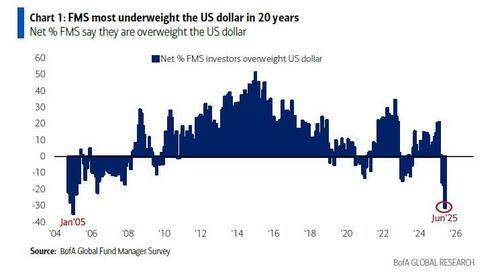
Gold vs The Dollar: The Death Of Fiat In One Chart Earlier today we reported that the latest BofA Fund Manager Survey confirmed what most already knew: that the shoeshine boy, the kitchen sink, and the basement-dwelling daytrader, not to mention everyone on Wall Street, were short the dollar. In fact, according to the FMS respondents, professional traders were effectively shorting the dollar in record amounts. But while we will leave aside the debate whether this record dollar short will transform into a record squeeze, another question is just as appropriate: is the decline and fall of the US dollar just a one-time flash in the pan, or is there something much more ominous here than meets the eye.The answer, it turns out, is the latter: the decline of the dollar has been truly a secular development, one which started over a decade ago but was kicked into higher gear in the aftermath of the 2022 Ukraine war when the weaponization of the US Dollar sparked a flight away from the greenback - i.e., dedollarization - by any regime that was worried it may be on the receiving end of SWIFT sanctions. But what is perhaps far more notable is that as Socgen shows, since 2024, dedollarization has not benefited any of the major reserve currencies as one would expect in a fiat world where one currency's loss is another currency's gain. Instead, the share of gold in the IMF's classification has increased.As the French bank goes on to note, the erosion of the dollar's share in global FX reserves, or de-dollarization, paused during the COVID crisis in 2020 but resumed in the second half of 2023. Since 3Q23, the share of USD FX reserves has fallen below 50%, representing a decline of -5.8%. The main beneficiary has been gold, which increased by +7.9% to 23.3%, reflecting how central banks are diversifying their dollar holdings...... although one look at the price of gold would have been sufficient.Perhaps the most surprising outcome of the dedollarization process is that process it has not benefited any of the major reserve currencies; indeed, the share of EUR, GBP, CNY and JPY has been declining too.Meanwhile, despite the laughable attempts of ECB head Christine Lagarde to paint the Eurozone and the euro as somehow more stable than the world's reserve currency - when just over a decade ago the euro was hours away from disintegration and only Mario Draghi's a last ditch gambit to do "whatever it takes" prevented the complete disintegration of the Eurozone - Gold has now overtaken the euro as the world’s second-most important reserve asset for central banks, driven by record purchases and soaring prices, according to the European Central Bank.As shown in the chart below, gold accounted for 20% of global official reserves last year, surpassing for the first time the euro’s 16%, and second only to the US dollar at 46%, data from an ECB report published on Wednesday showed.“Central banks continued to accumulate gold at a record pace,” the ECB wrote, adding that central banks for the third year in a row acquired more than 1,000 tonnes of gold in 2024, a fifth of the total global annual production and twice the annual amount in the decade of the 2010s.As the FT notes, the stock of gold held by central banks worldwide is approaching the historic highs of the postwar Bretton Woods era. Until 1971, global exchange rates were fixed to the dollar, which in turn could be converted into gold at a fixed exchange rate. That all ended with the Nixon gold shock in 1971. Central bank gold reserves, which peaked at 38,000 tonnes in the mid-1960s, rose again to reach 36,000 tonnes in 2024, according to the latest ECB numbers. “Central banks worldwide now hold almost as much gold as they did in 1965,” the ECB report said.Large buyers last year included India, China, Turkey and Poland, according to the World Gold Council.While there are no indications that the relentless demand for gold among official buyers is slowing, the ECB noted that the supply of gold in recent decades increased during times of high prices: “If history is any guide, further increases in the official demand for gold reserves may also support further growth in global gold supply.”Which is a wonderful theoretical thought experiment, the only problem is that now that gold has become a Giffen good (where demand only goes up with price), any incremental supply will be quickly absorbed by even more demand. And if that is indeed the case, and the current trajectory of gold accumulation and dedollarization persist, expect gold to surpass the dollar as the world's preferred reserve currency sometime in 2030... right around the time US debt will be $50 trillion and bitcoin will be well over $1 million. Which is ironic: a handful of powerful brought the end of the Bretton Woods world in the early 1970s, sparking an anti-gold regime which was adopted by a world kicking and screaming in disgust. 50 years later, without any outside influence, the world in which gold is once again the reserve "currency" has effectively returned. Nature is healing. More in the full Socgen note available to pro subs. Tyler DurdenTue, 06/17/2025 - 22:35

The city received a letter from U.S. Attorney Bill Essayli warning the police could expose city staff and elected officials to federal prosecution.

A new state energy siting board in Pennsylvania may be a stalking horse for fossil fuel and nuclear interests in that state, The post State vs. Local Control Over Energy Siting Sparks Debate In Pennsylvania appeared first on CleanTechnica.

Colombia’s Senate has approved a labor bill that is expected to grant workers more overtime pay while making it harder for companies to hire employees on short-term contracts

U.S. Treasury yields were little changed on Wednesday as investors awaited the Federal Reserve’s rate policy decision and more insight on the economic impact of President Donald Trump’s tariffs and escalating tensions in the Middle East.At 6:42 a.m. ET, the benchmark 10-year Treasury note fell 1 basis point to 4.375%. The 2-year Treasury yield also slipped 1 basis point to 3.939%.One basis point is equivalent to 0.01%, and yields and prices move in opposite directions.The Fed’s interest rate decision will be announced at 2 p.m. ET. Traders are pricing in a 99.9% chance that the central bank will hold interest rates steady, according to the CME FedWatch Tool. Federal Open Market Committee members forecast only two rate cuts this year.“A lot has happened since their last meeting in early May, including the dialling back of China tariffs, the Moody’s downgrade of the US credit rating, as well as the significant escalation in the Middle East,” Deutsche Bank analysts said in a note. “So given that uncertainty and the potential for fresh inflationary spikes, they’re widely expected to keep rates on hold again, and it means the focus will be on the dot plot for where they expect rates to go next.”They added: “Our US economists think it’ll only signal one rate cut this year, which would be a hawkish shift from March, when they still signalled two cuts. However, they think it’s a close call, and they expect the Fed to mostly maintain existing signals about policy.”Investors are also awaiting economic data, including housing starts for May and preliminary building permits. Weekly jobless claims will be released in the morning.The bond market will be closed on Thursday for the Juneteenth holiday.

A U.S. military strike against Iran is one of the options Trump is considering, current and former administration officials told NBC News. U.S. stocks retreated Tuesday as Trump’s rhetoric on Iran ramped up. Asia markets traded mixed Wednesday. Japan exports in May declined 1.7% year over year, according to data from Japan’s trade ministry released Wednesday. OpenAI CEO Sam Altman said Meta had sought to hire “a lot of people” from the artificial intelligence company. The U.S. Senate on Tuesday passed the GENIUS Act, a bill that establishes federal guardrails for U.S. dollar-pegged stablecoins. Investors think global stocks will be the best-performing asset in the next five years.Hopes of a quick ceasefire between Israel and Iran were dashed by several social media posts from U.S. President Donald Trump. As he took an early departure from the Group of Seven summit, Trump said it “certainly has nothing to do with a Cease Fire” and that he was involved in something “much bigger than that.”What’s bigger than a ceasefire? An escalation in conflict on the prospect of the U.S. joining the hostilities in the Middle East. Trump, on his social media platform Truth Social, threatened Iran’s leader Ayatollah Ali Khamenei that he is an “easy target” and wants him to “surrender.”Trump’s posts on Truth Social brought U.S. stocks lower and caused oil prices, which were on the retreat Monday, to shoot up more than 4% during Tuesday’s trading session in America. A weaker-than-expected U.S. retail sales report in May also added to the heavy sentiment in markets.The U.S. Federal Reserve’s rate-setting meeting will conclude Wednesday. While central bankers are expected to leave interest rates unchanged, the committee will release updated projections of where they see rates going. Chair Jerome Powell will also answer questions from the media at this press conference. All of those are market-moving events — so it’s a relief, at least, they come from official communiques.What you need to know todayTrump weighs strike on IranA U.S. military strike against Iran is one of the options Trump is considering, after meeting with his top national security advisors on Tuesday afternoon, current and former administration officials told NBC News. Earlier in the day, Trump wrote on Truth Social that the U.S. knows “exactly” where the Iran’s leader, Ayatollah Ali Khamenei, is “hiding,” and demanded “UNCONDITIONAL SURRENDER!”U.S. markets fell while Asia trades mixedU.S. stocks retreated Tuesday as Trump’s rhetoric on Iran ramped up. The S&P 500 fell 0.84%, the Dow Jones Industrial Average shed 0.7% and the Nasdaq Composite was down 0.91%. Asia-Pacific markets were mixed Wednesday. At 1:30 p.m. Singapore time, Japan’s Nikkei 225 rose 0.77% even as the government reported a drop in exports in May, while South Korea’s Kospi added 0.56%. Hong Kong’s Hang Seng Index, however, lost 1.23%.Exports from Japan fall in MayJapan exports in May declined 1.7% year over year, according to data from Japan’s trade ministry released Wednesday. While that drop fares better than the 3.8% decline expected from a Reuters poll of economists, it’s still the steepest fall since September 2024 and reverses the 2% growth in April. Exports to the U.S. dropped 11.1% from a year earlier, much worse than than the 1.8% fall in April.Meta trying to poach OpenAI staff: AltmanOn a podcast released Tuesday, OpenAI CEO Sam Altman said Meta had sought to hire “a lot of people” from the artificial intelligence company, and had offered signing bonuses as high as $100 million — but “so far none of our best people have decided to take them up on that.” Meta CEO Mark Zuckerberg is frustrated with his firm’s standing in the AI space, sources told CNBC.U.S. passes landmark crypto billThe U.S. Senate on Tuesday passed the GENIUS Act, a landmark crypto bill that establishes federal guardrails, including full reserve backing, monthly audits, and anti-money laundering compliance, for U.S. dollar-pegged stablecoins. It also opens the door to a range of issuers, including banks, fintechs, and major retailers looking to launch their own stablecoins or integrate them into existing payment systems.[PRO] Global stocks will reign: InvestorsThe era of U.S. exceptionalism might be coming to an end. Not only have global stocks vastly outperformed those in America year to date, investors also think they will be the best-performing asset class over the next five years, according to the results of Bank of America’s latest fund manager survey.And finally...Chip Somodevilla | Getty ImagesFederal Reserve Chair Jerome Powell.The Fed is likely to keep rates the same but give a forecast that moves markets. What to expectWhile any immediate movement on interest rates seems improbable, the Federal Reserve’s policy meeting, which concludes Wednesday, will feature important signals that still could move markets.Among the biggest things to watch will be whether Federal Open Market Committee members stick with their previous forecast of two rate cuts this year, how they see inflation trending, and any reaction from Chair Jerome Powell to what has become a concerted White House campaign for easier monetary policy.As things stand heading into the meeting, markets are pricing in the next cut to come in September, which would be the one-year anniversary of a surprisingly aggressive half-percentage-point reduction the FOMC instituted amid concerns over the labor market. The committee added two more quarter-point moves by the end of the year and has been on hold since.

This is CNBC’s live blog covering European markets.Airbus shares riseKevin Carter | Getty ImagesA JetBlue Airways Airbus A321 departs from Harry Reid International Airport en route to Boston on March 15, 2025, in Las Vegas, Nevada.Ahead of a business update on Wednesday, Airbus raised the upper end of its dividend payout ratio and confirmed its full-year guidance.The company said that it would extend “the upper range of the dividend payout ratio to 30-50% from the current payout ratio of 30-40%.”Shares were last seen trading 1.4% higher.— Chloe TaylorGilts see muted reaction to UK inflation printU.K. government bonds, known as gilts, strengthened slightly after inflation came in in line with analysts’ expectations.The yield on the benchmark 10-year gilt was around 2 basis points lower by 7:07 a.m. in London. Yields on 2- and 20-year gilts were down by around 1 basis point, while 5- and 30-year gilt yields remained unchanged.Bond prices and yields move in opposite directions.— Chloe TaylorUK inflation cools to 3.4% in May, as expectedU.K. inflation cooled slightly to 3.4% in the year to May, data from Britain’s Office for National Statistics showed on Wednesday.The reading was in line with analyst expectations.A month earlier, inflation unexpectedly surged to 3.5%.— Chloe TaylorGood morning, here are the opening callsYui Mok – Pa Images | Pa Images | Getty ImagesA view of the London skyline during sunrise looking east, including Canary Wharf, from Horizon 22, London’s highest free viewing platform. Picture date: Friday September 15, 2023. Good morning and welcome to CNBC’s live blog covering European financial market action and the latest regional and global business news, data and earnings.Futures data from IG suggests sharp falls across European markets at the open, with London’s FTSE looking set to open 52 points lower at 8,827, Germany’s DAX down 245 points at 23,447, France’s CAC 40 down 75 points at 7,665 and Italy’s FTSE MIB 329 points lower at 39,568.Global investors continue to assess ongoing fighting between Israel and Iran tensions after continued missile attacks and airstrikes on Monday.Oil prices have risen on supply worries, and the price of gold has also increased amid a flight to safe haven assets after the conflict erupted last week.Those prices rose further overnight, and U.S. stock futures turned lower, after U.S. President Donald Trump signaled a further escalation in attacks could be coming as he urged Iranians to evacuate Tehran.— Holly EllyattWhat to look out for on WednesdayThe U.S. Federal Reserve’s latest monetary policy decision is due Wednesday afternoon. Fed funds futures are pricing in an almost 100% likelihood that the central bank will keep rates unchanged, as per CME’s FedWatch tool, despite U.S. President Donald Trump’s continued pressure on Fed Chief Jerome Powell for a rate cut.Michael Nagle | Bloomberg | Getty ImagesTelevision stations broadcast Jerome Powell, chairman of the U.S. Federal Reserve, speaking after a Federal Open Market Committee meeting, on the floor of the New York Stock Exchange on May 7, 2025.Investors will be keeping a close eye on Powell’s post-meeting comments and for the central bank policymakers’ forecast on rate policy, as the Federal Open Market Committee will be sharing members’ “dot plot” of rate expectations.In Europe, U.K. investors will be keeping a close eye on inflation data from the U.K. for May, with economists expecting the consumer price index to have risen 3.4% in the year to May. Elsewhere, Sweden’s Riksbank publishes its latest interest rate decision on Wednesday.There are no other data or major earnings reports due.— Holly Ellyatt
High Arctic Overseas Announces Normal Course Issuer Bid

Chinese companies have increasingly turned to the internet to sell directly to consumers, a fast-growing industry known as cross-border e-commerce. But if Chinese exporters are to compete globally, they need to focus on the hard task of building a brand. Many companies are eager to enter the U.S. market, but face greater urgency to differentiate through building a brand.This report is from CNBC’s The China Connection newsletter, which brings you insights and analysis on what’s driving the world’s second-largest economy. Each week, we’ll explore the biggest business stories in China, give a lowdown on market moves and help you set up for the week ahead. Like what you see? You can subscribe here.The big story“Do you need a U.S. warehouse?”“Do you need a Mexico warehouse?” “Shipping to Europe?”Salespeople, speaking in Mandarin Chinese, weren’t shy about pushing their logistics services when I attended the 10th Shenzhen International Cross-Border E-Commerce Expo this week. One logistics company even hired foreign-looking models in glittery silver dresses to parade around the venue.It’s one of the biggest events of the year for companies selling from China to the U.S. and other countries via the internet. In the midst of a tepid truce in the U.S.-China tariff war, many companies appeared eager to enter the U.S. market.But the game to survive has changed.“The past 30 years have helped Chinese companies to become very mature in supply chain integration,” Tina Hsu, partner at startup AIGC Empower, told me in Mandarin at the expo. “Today, if there is a tool that can help [businesses] tell a story better, resonate with users ... they could go overseas with the identity of a brand to operate in a healthier manner that’s longer term and with higher profits.”AIGC Empower claims it has those tools. At a joint launch with Amazon and Wayfair in Zhuhai, China, last month, Hsu said AIGC introduced two generative AI-powered products: a system for quickly researching local markets to understand consumer needs, and a tool for producing images for product advertisement. The service starts at 10,000 yuan ($1,390) per product per year — and has already received around 100 orders, Hsu said.“To be honest, it’s not every customer here who can appreciate the value” of our product and the need for branding, she said, noting it’s Chinese entrepreneurs who studied abroad that understand it best. But she warned that without inherent differentiation, Chinese companies will find it hard to survive overseas in the next 30 years.Spending more on adsWhile a few companies with Chinese roots such as Temu and Shein have grabbed the most attention when it comes to cross-border e-commerce, several smaller Chinese businesses have also been tapping the internet to sell directly to overseas consumers, as competition at home has intensified.“The U.S. consumer market is still the world’s largest, and the destination for most cross-border e-commerce sellers,” said Li Xiaoming, distribution manager at Miao Shou, which sells software that allows merchants to analyze data from multiple e-commerce platforms in one place. That’s according to a CNBC translation of his Mandarin-language remarks.Although companies have turned to other countries, they’re still holding onto some resources for deploying into the U.S. market — if conditions improve in the next few months, he said.Regardless, Chinese sellers are piling into the cross-border e-commerce trend.Miao Shou claimed that it had a total of 800,000 customers as of June, with around 200,000 companies joining the platform in the past six months. Li said the company aims to double clients’ sales transaction volume on its platform this year.To stand out in such a competitive environment, these companies need better branding and marketing, especially in the current trade climate.“We believe tariffs this time mark a process of complete market reshuffling,” pushing out companies that previously only relied on price, not product quality, to compete, Bear Huo, China general manager at fintech startup FundPark, said in Mandarin, translated by CNBC.With $750 million in financing from Goldman Sachs and HSBC, FundPark lends money to smaller Chinese businesses selling their wares overseas. Huo, who used to work at Alibaba, said that the startup has become an official loan provider for certain Chinese sellers on Walmart, and aims to reach a similar partnership with sellers on Amazon later this year.Huo said FundPark is lending more to businesses for advertising as clients have ramped up their marketing spend to up to 20% of the product transaction value — a jump from 3% to 5% in 2023.While ad spending can lead to short-term spurts in sales, building a brand is a longer-term process, and a far more challenging task. Even advertising legend John Hegarty has described the difficulties of getting companies to make bold, transformational moves in order to stand out in the market. But if Chinese exporters are to compete globally, they need to focus on the hard task of building a brand.It’s similar to what’s playing out in China’s cut-throat electric-car industry. Companies have been slashing prices and offering more high-tech features, but to stand out over the longer-term, they need to create brands that resonate with consumers.Eyeing legal protectionsSome Chinese companies believe they already have what it takes to build a brand, but lack the legal resources to protect themselves — especially as market incumbents launch targeted lawsuits that can force a Chinese seller to go out of business.It’s become such a pressing challenge that a group of Chinese merchants have backed a new platform that uses a low-cost insurance structure for litigation services that can otherwise be quite expensive, according to Jack Zhang, secretary-general at the Shenzhen Cross-Border E-Commerce Association’s legal insurance division. He’s leading the project with a team of about 30 people.His plan is to group lawsuits into the thousands or tens of thousands, thereby negotiating a lower rate with law firms in the U.S. or another market. It’s far from an operating service, and Zhang hopes he can reach the 1,000-case threshold around this time next year.Several companies at the expo also advertised services from compliance to business registration — getting a U.S. trademark will cost the equivalent of $485, now available at a $150 discount, one flyer said. But as many of the vendors appeared to mimic each other’s style, only attempting to undercut others on price, it’s clear the concept of a brand has yet to take off.Top TV picks on CNBCXiaopeng He, founder of Xpeng, talks about pressures and competition in the Chinese EV market: over-capacity, price wars, and technological innovations. He says the Turing chip is a necessary invention to help Xpeng transition to a large tech company.Hong Hao, managing partner, at Lotus Asset Management, talks about where he’s seeing opportunities in the China markets: biotech, bubble tea, and Pop Mart.Nicholas Burns, former ambassador to China, joins “Closing Bell Overtime” to talk the role China could play in the Iranian-Israel conflict.Need to knowChina’s retail sales sharply beat expectations in May. Sales recorded their largest jump since December 2023, boosted by government subsidies and surging online shopping as a major e-commerce sales event started early. Industrial output and fixed-asset investment both saw growth soften from the prior month and missed expectations.U.S.-China renewed trade truce left military-grade rare-earth issue unresolved. That’s according to a Reuters report, citing two people briefed on the London bilateral meeting. Beijing has yet to loosen its grip on exports of some specialized rare-earth magnets, while U.S. maintains curbs on exporting cutting-edge AI chips to China.China resumed Boeing’s jet deliveries. Boeing delivered a new 787-9 aircraft to China’s Juneyao Airlines on Saturday, months after Beijing had suspended the U.S. aerospace giant’s deliveries amid tit-for-tat retaliation against Washington. That delivery comes after China agreed on dialing back some punitive measures against the U.S. with more trade negotiations underway.— Anniek BaoIn the marketsChinese and Hong Kong stocks fell early Wednesday amid mixed trading in the region, as escalating tensions between Israel and Iran weigh on investor sentiment.Mainland China’s CSI 300 was down 0.18%, while Hong Kong’s Hang Seng Index — which includes major Chinese companies — had lost 1.7% as of 2:00 p.m. local time.Coming upJune 18-19: Lujiazui Financial Forum in ShanghaiJune 19: Deadline for ByteDance to sell off TikTok U.S., likely to be extendedJune 24-26: World Economic Forum’s “Summer Davos” in Tianjin; AIIB Annual Meeting in Beijing

Airbnb Inc. (NASDAQ:ABNB) co-founder and CEO Brian Chesky has credited his father’s tough love—not praise—for instilling the mindset that helped him build a billion-dollar company.What Happened: Speaking on Simon Sinek's “A Bit of Optimism” podcast, which was made public in February of this year, Chesky shared that his father never complimented his intelligence and instead rewarded effort over innate ability."My dad never told me I was talented or smart and he probably did me a service," Chesky said, adding, "He only rewarded effort.""I think there's a lot of studies about the growth mindset that if you reward a child for being intrinsically good, they're going to be afraid to try because they don't want to disprove you. But if you reward effort, the only way to fail is to not give it your all."See Also: Ross Gerber Slams Airbnb Over Customer Support, Vows To ‘Never Use It Again’ After Palisades Fire ExperienceThe CEO then gave the example of UCLA's legendary basketball coach John Wooden while discussing his leadership philosophy. Chesky recalled Wooden’s response when asked about the secret behind his record-setting coaching career.According to Chesky, Wooden believed in seeing ...Full story available on Benzinga.com
Canadians will be get bigger ACWB payments from the feds in July Daily Hive VancouverCanadians can expect even larger government payouts in July blogTOSome Canadians receiving increased GST credit payments next month blogTO
Breakthrough implementation enables a large national health system to retire nearly 800 legacy applications, implement active archiving, and unlock over $65M to date in annual savings
Meta Invents New Way to Humiliate Users With Feed of People's Chats With AI 404 MediaWe uncovered how Meta's AI app was full of accidental public posts that were really personal. It's now trying to fix that. Business InsiderThe Meta AI App Lets You ‘Discover’ People’s Bizarrely Personal Chats WIREDMeta AI users confide on sex, God and Trump. Some don’t know it’s public. The Washington PostMeta AI warns your chatbot conversations may be public. Here's how to keep them private. Mashable

PARIS, June 17, 2025 /PRNewswire/ -- Datawords Group is proud to announce the appointment of Eric Chaniot, Vice President and General Manager at Microsoft, as the newest member of its Board of Directors. With over three decades of experience in the tech industry, his arrival further...

'EVERYONE SHOULD IMMEDIATELY EVACUATE TEHRAN!' ... TRUMP WARNS IRANIANS TO GET OUT OF THE CAPITAL ... DONALD TRUMP: Iran should have signed the “deal” I told them to sign. What a shame, and waste of human life. Simply stated, IRAN CAN NOT HAVE A NUCLEAR WEAPON. I said it over and over again! Everyone should immediately evacuate Tehran!

Snowflake Inc (NYSE:SNOW) has entered into a strategic partnership with Interpublic Group of Companies, Inc's (NYSE:IPG) Acxiom business to build and deliver an AI-powered marketing data infrastructure.Unique interactions through one-on-one conversations during Snowflake's annual conference provide an "on-the-ground view of trends that we expect to drive fundamentals for the software market over the next 12-18 months," according to JPMorgan.The Snowflake Analyst: Analyst Mark Murphy reiterated an Overweight rating and price target of $225.Check out other analyst stock ratings.The analyst provided these quotable quotes from ...Full story available on Benzinga.com
Oil and gold send conflicting signals on Iran war angst. US dollar climbs Forexlive | Forex News, Technical Analysis & Trading ToolsU.S. dollar’s tarnished reputation highlighted by latest Middle East conflict The Globe and MailUS Dollar: Can Rising Geopolitical Tensions Spark a Trend Reversal? YahooEUR/USD forecast: Dollar still on the ropes despite Israel-Iran conflict intensifying FOREX.comUS dollar firms versus yen, Swiss franc as Middle East tension simmers KITCO
Descartes' MyCarrierPortal leverages real-time Incident Reports to continually vet your network.The post Descartes: protecting freight with advanced fraud prevention technology appeared first on FreightWaves.