2026-02-15
SCIENTIFICALLY UNREFUTED: A Breakthrough Invention Saving Millions of Lives and Billions of Dollars Awaits a Public Comparative Evaluation Within CPRIT's $6 Billion Cancer Program
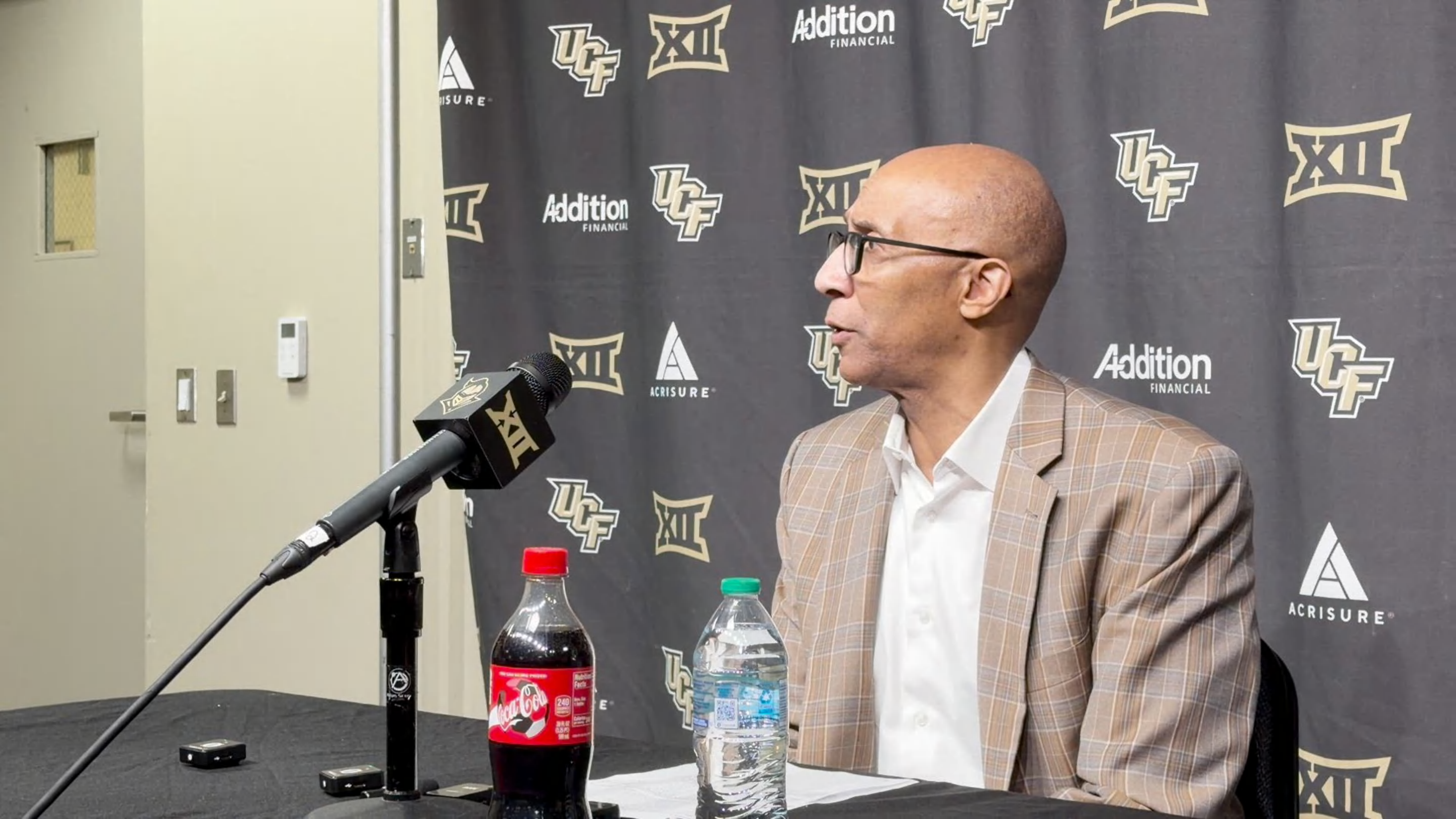
DALLAS, Feb. 15, 2026 (GLOBE NEWSWIRE) -- In PDF https://bit.ly/4qCHVYg — The Crosetto Foundation for the Reduction of Cancer Deaths, acting on its mission to provide cost-effective life-saving solutions to the public, calls for an immediate comparative scientific review to resolve the ongoing exclusion of unrefuted cancer-detection breakthroughs. At the North Texas Cancer Advocacy Breakfast on February 11, 2026, Italian-American scientist Dario Crosetto presented a challenge to the leadership of the Cancer Prevention and Research Institute of Texas (CPRIT). He is the inventor of a technology recognized as a breakthrough in 1993 by a major public, international scientific review at FERMILAB [1].Based on this and other inventions, the U.S. Government in 1994 granted him a Green Card for ‘Exceptional Ability‘ in just 24 hours from submission. One entry, explicitly stated on page 8 of the official documentation, identifies the: ‘Digital programmable level-1 trigger with 3D-Flow assembly' [2].Furthermore in 1995, Crosetto received a $1 million grant [3] from the U.S. Department of Energy to conduct a feasibility study of the 3D-Flow invention, which was successfully completed and documented in a peer-reviewed publication [4].Despite these proven technical, scientific, and cost-effective advantages in detecting particles and cancer at the near-cellular level—representing a quantum leap in early detection—this technology remains outside the scope of CPRIT's public comparative scientific evaluation.A Media Snippet accompanying this announcement is available by clicking on this link.The Question of Funding Caps: During the Q&A session with CPRIT CEO Dr. Kristen Doyle, Crosetto raised a critical concern regarding the accessibility of funding for large-scale hardware prototypes.Crosetto asked:‘We all know that early cancer detection is the most cost-effective way to save lives. My question is this: if there is a project that costs more than $200,000 — because that appears to be the cap in the CPRIT funding opportunity I reviewed — and if a project requires $10 to $20 million, is there a possibility to submit that project to CPRIT's scientific committee for evaluation, to determine whether it is scientifically sound based on solid scientific grounds? Is there an opportunity to submit projects exceeding $10 million?'Dr. Doyle responded that all projects funded by CPRIT must undergo peer review. She explained that experts in the relevant fields, from across the country and internationally, review applications and recommend those considered strongest scientifically. She added that CPRIT funds approximately 10% of submitted applications and emphasized that, while $6 billion represents a significant investment, careful evaluation is necessary to ensure responsible use of public funds. She also noted that proposals are overseen by the governing board's oversight committee, indicating two members present in the room: Will Montgomery and Dr. Craig Rosenfeld, who serve as citizen volunteers responsible for ensuring that funding decisions follow established rules and select the strongest proposals.(See video of the exchange here) [5].Crosetto briefly repeated the question asking whether a funding cap existed, after which the emcee indicated that further discussion would occur after the session. Dr. Doyle responded that she would be happy to speak afterward.Follow-Up Discussion After the EventAt the conclusion of the event, Crosetto spoke with Mr. Will Montgomery, who indicated that CPRIT has funded projects in the range of $15 million and even above $20 million. Crosetto then asked where such funding opportunities were described, as the opportunities identified on the CPRIT website for projects appeared limited to approximately $250,000.Public information regarding Mr. Montgomery's role indicates that he oversees operational aspects of CPRIT's funding programs, including Academic Research, Prevention, and Product Development, ensuring that review processes and grant administration are conducted in compliance with state guidelines.In a previous press release dated 15 September 2025 [6], Crosetto had noted:‘Most grants focus on recruitment and training ($2–5 million over five years). The High-Impact/High-Risk Research Awards (HIHR) program [7], despite its name, is limited to $250,000 over two years, far short of the approximately $20 million required for two prototypes.'No clarification has yet been received explaining how projects in the $15–20 million range are funded within CPRIT's structure. Mr. Montgomery advised Crosetto to contact Dr. G. Kenneth Smith, Chief Product Development Officer at CPRIT. Crosetto subsequently contacted Dr. Smith and sent a detailed letter [8] and is awaiting a response.Public information regarding Dr. Smith's role indicates that he oversees CPRIT's Product Development Research Program, participates in the Program Integration Committee (PIC), and contributes to the evaluation and due-diligence processes for technologies considered for CPRIT funding.A Call for Accountability and ComparisonIt would be logical and fair to taxpayers if applicants requesting grants in the range of $15–20 million or more — whether for new drugs, vaccines, medical imaging devices, liquid biopsy technologies, immunotherapies, or prevention programs — provide quantitative estimates of expected reductions in cancer mortality and healthcare costs attain with their project (or combined with other existing techniques. Such proposals should include plans for measurable validation through controlled population similar to this ROADMAP Table [9].For example, a program could be tested on a sample population of at least 10,000 individuals aged 55–74 in a geographic area where the cancer mortality rates have remained stable over time. After funding is awarded and the program implemented, measured changes in cancer mortality rates in a specific limited territory would provide objective evidence of success or failure.In 2009, Crosetto submitted a proposal to CPRIT that did not receive any scientific refutation but was not funded. Now he requests that the technical-scientific demonstrations presented in his publications be publicly compared with funded projects and those currently under evaluation through a public, transparent and comparative scientific review.Distribution of Technical DocumentationCrosetto provided the following materials during the event:A paper copy of a three-page letter [8].A 57-page technical-scientific demonstration [10] supported by references, simulations, hardware feasibility, and functional validation of the 3D-Flow and 3D-CBS inventions, which are designed to detect tumors with fewer than 100 cells—far earlier than the 1,000,000 cells corresponding to 1 mm of body tissue, currently needed to detect cancer with an MRI or CT technology—in a 2-minute, $200 screening, with the potential to save billions of dollars in scientific and medical applications while advancing scientific progress and, more importantly, save millions of lives through a cost-effective early detection of minimal abnormal biological processes preceding disease, including cancer, at a highly curable stage.A four-page [13] summary of the 2025 Press Releases.A two-page summary [11] comparing the inventions with the state of the art, previously distributed in 1,200 copies to scientists attending the most important international conference in the field, IEEE NSS-MIC-RTSD Conference in Yokohama, Japan (1–7 November 2025).Copies were provided to Mr. Will Montgomery, Dr. Jeff Fehlis, Mr. Steve Eagar, Ms. Kay Kamm, and Mr. Zac Covar, Chief of Staff to Representative Venton Jones.When Crosetto offered the same documentation to CPRIT CEO Dr. Kristen Doyle, requesting it be forwarded to CPRIT scientists for evaluation, she expressed concern about avoiding any appearance of preferential treatment toward a specific project. The exchange reflected CPRIT's emphasis on maintaining fairness and procedural neutrality in handling submissions.While Crosetto expressed surprise that a CEO would not immediately ‘hunt' for a potential breakthrough to pass to her scientific team, the exchange underscored a systemic barrier: the difficulty of introducing paradigm-shifting hardware into a grant system designed primarily for academic and clinical research.Crosetto's position is that organizations tasked with reducing cancer mortality should, by their very nature, be interested in reviewing any proposal that demonstrates a substantial impact. Furthermore, scientists acting with scientific integrity must acknowledge superior technology, much like a physician chooses the best possible treatment for a patient's health. In a public comparative evaluation, the truth will emerge from the technical-scientific evidence and calculations presented by each party. Should disagreements persist, they can be resolved by funding two parallel experiments aimed at proving both claims; the empirical results from these experiments will ultimately determine which solution is correct.Additional Follow-UpUpon leaving the event, Crosetto briefly met Dr. Craig Rosenfeld, whom he had previously met at the ACS CAN Cancer Advocacy Breakfast 2024 event [12]. Due to time constraints, a discussion was not possible at that moment; however, Dr. Rosenfeld later received a copy of the same letter.Public information indicates that members of the CPRIT Oversight Committee, including Dr. Rosenfeld, are appointed by state leadership and hold final voting authority on grant approvals while providing strategic oversight of funding decisions.Conclusion The central question raised by this exchange is not whether any single proposal should be funded, but whether a scientifically documented invention demonstrating substantial improvements in early cancer detection and cost efficiency should receive a transparent, public, and comparative scientific evaluation alongside currently funded approaches.CPRIT's mission is to reduce cancer mortality through responsible use of taxpayer resources and rigorous scientific review. A public comparative evaluation of the 3D-Flow and 3D-CBS demonstrations would allow independent experts to determine their scientific merit within the same framework applied to other funded projects. Such an approach would strengthen public confidence, ensure fairness to taxpayers, and align scientific evaluation with the shared objective of reducing premature cancer deaths.The 3D-Flow and 3D-CBS inventions have stood for decades without a formal scientific refutation. The question remains: In a mission to eradicate cancer backed by $6 billion in taxpayer funds, can the system adapt to evaluate a breakthrough that has demonstrated it changes the very nature of detecting ‘good events' in physics experiments and detecting tumors in medical imaging? Scientific progress is not merely about following administrative rules that are effectively killing the rules in physics, biology and the laws of nature, but about ensuring that the most effective solutions are given a seat at the table.Sincerely,Dario CrosettoDeSoto, Texas 75115 – USAEmail: <a href="mailto:




.jpeg)